You know that moment when you message a company at 11 PM about a billing mess and somehow get a real answer in seconds? No sleepy night-shift guy typed that. It was an AI chatbot, doing its thing quietly in the background and these days that’s not the exception, it’s just how things work now.
Remember the old way hold music, endless queues, explaining the same problem to three agents who never have your previous notes? AI chatbots didn’t just make that faster. They basically tore the whole setup down and rebuilt it. Once you start noticing how often you’re chatting with a bot without even realizing it, you can’t really stop noticing.
Why Customer Service Needed a Shake-Up
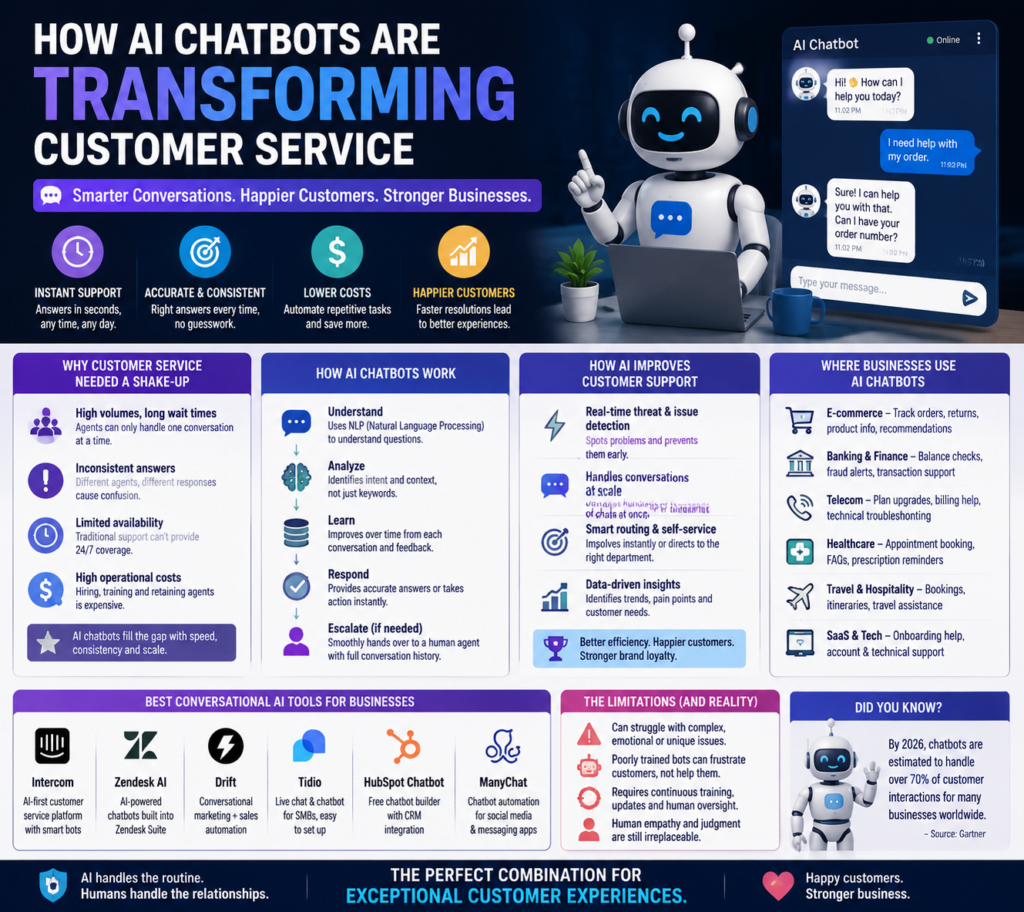
Here’s the honest truth the old support model was never built to handle scale. You hire people, train them, hope they stick around past month three, then start over when they don’t. Slow. Pricey. And customers still end up stuck in a queue during busy hours, or worse, out of luck after 6 PM.
Then there’s the consistency mess. Ask two agents the same question, and you might get two different answers doesn’t exactly scream “trust us.” People want quick, correct, available anytime support. Asking a human-only team to nail all three every time? Tall order, even for great teams.
So yeah. That’s basically the gap AI chatbots slid right into.
How AI Chatbots Actually Work in Real Conversations
Imagine it’s 2 AM and someone’s stuck on a return policy. Rather than wait till morning, they type into the chat bubble and get a real answer almost instantly. No hold music. No “your call is important to us” looping for the fortieth time.
What’s changed under the hood matters too. These bots don’t just scan for matching keywords anymore they try to figure out what you actually mean. Phrase the same question three different ways, and a decent chatbot still lands on the right answer. That’s the jump from clunky scripted bots to what people now call conversational AI tools, which lean on natural language processing to read context instead of needing exact phrasing.
And honestly, the learning curve on these things is kind of wild. Run enough conversations through one, and it starts catching on by itself recurring complaints, common phrasing, even whether someone sounds annoyed or just mildly curious. Nobody’s manually coding that in; the system just picks it up.
Customer Service Automation Beyond Just Chat
But chat is just the surface layer at this point. These systems track packages, book appointments, push refunds through, and sometimes reach out before you’ve noticed there’s a problem flagging a delayed shipment before you go looking for it yourself.
E-commerce stores lean on this constantly. The cart gets abandoned, and within minutes, a chat bubble pops up offering help or a small discount to seal the deal. Banks do something similar for balance checks and fraud alerts. Telecom companies run plan upgrades and basic troubleshooting through more or less the same setup.
None of this is about replacing people, to be clear. It’s about clearing out the repetitive stuff so human reps can spend their energy where it counts. That’s customer service automation doing exactly what it’s good at eating up volume, not nuance.
How AI Chatbots Improve Customer Support Efficiency
This is where the real payoff shows up. One chatbot, running on decent infrastructure, can juggle hundreds or thousands of conversations at once try getting a human team to pull that off without hiring an army.
Wait times shrink from “call back later” to basically instant. Customers stop bouncing between departments because the bot routes them right the first time or solves it on the spot. And since a chatbot doesn’t get tired or distracted after six hours of a shift, the answers stay sharp at 3 AM just as much as at 9.
There’s a cost side too businesses spend less on staffing for repetitive stuff, and those savings often go toward better training for agents handling the messy, high-stakes, emotionally loaded conversations that genuinely need a real person.
Best Conversational AI Tools for Businesses Today
So what’s actually available right now? Loads of businesses, big or small, are picking up platforms built for this tools that plug into CRMs, ticketing systems, even social media DMs, all under one roof.
The sharper tools don’t just spit out canned replies anymore. They read sentiment, know when to escalate, and hand things off to a human with full context attached, so nobody repeats their whole story from scratch. That handoff used to be one of the most annoying parts of getting help fixing it has made a real difference.
What surprised me, digging into this, is how accessible it’s gotten for smaller players. Cloud-based conversational AI tools are cheap enough now that a small online shop can run something genuinely solid, no in-house engineering team required.
The Limitations Worth Knowing About
It’s not all sunshine, and pretending otherwise would be dishonest. Bots can still whiff badly on complex or emotionally charged situations someone venting about a real problem usually doesn’t want a calm, scripted reply bouncing back. If the handoff to a human drags on too long, or never happens, people feel brushed off, and fair enough too.
There’s the setup headache as well. A badly trained bot causes more friction than it solves, looping people through useless replies that push them further from an answer instead of closer. Getting it right takes constant tweaking this isn’t a set-it-and-forget-it kind of tool.
Conclusion
AI chatbots have quietly turned into a real backbone for customer service, handling everything from simple questions to multi-step processes that used to eat up entire teams. They’re not flawless, and they’re nowhere close to replacing a skilled human agent once things get genuinely complicated. But for sheer speed, availability, and consistency? Hard to beat. The businesses doing this well tend to split the work smartly automation for the routine stuff, real people for everything that actually needs a human brain.
FAQs
1. Can AI chatbots deal with complicated customer complaints by themselves? Not really, no. They’re solid for routine, repetitive stuff, but anything complex or emotionally heavy usually still needs a human stepping in at some point.
2. How does a chatbot actually figure out what a customer means? Through natural language processing, it reads intent instead of just hunting for matching keywords, so even oddly phrased questions still land on the right answer.
3. Is this kind of tech only for big companies with big budgets? Nope, not anymore. Affordable cloud-based conversational AI tools have opened this up to small and mid-sized businesses too, not just the enterprise crowd.
4. Does this mean human customer service reps are getting replaced? Not entirely. Bots usually take the repetitive, low-stakes queries off their plate, which frees up humans for the harder conversations that actually need judgment calls.
5. What separates a genuinely good chatbot from an annoying one? Smooth handoffs when a human’s needed, decent intent recognition, and the ability to keep learning from real conversations that combo usually separates the helpful ones from the frustrating ones.