My uncle’s been farming the same stretch of land for almost thirty years, and even he admits things look different now. Drones flying over the wheat fields. An app on his phone telling him exactly which patch of soil needs water. A few years back, this would’ve sounded like science fiction to him. Now it’s just Tuesday. That’s basically the story of AI in agriculture right now quietly becoming normal, one field at a time.
Farming has always been a game of educated guesses. How much rain is coming? Is that yellowing patch a nutrient problem or early disease? When exactly should this be harvested? For generations, farmers relied on experience and a bit of luck. AI doesn’t remove the guesswork entirely, but it shrinks it down to something far more manageable.
Why Farming Needed This More Than Most Industries
Farming margins are brutal, let’s just be honest about that. Weather changes. Soil’s never quite the same from one patch to the next. Pests show up uninvited. Prices swing around for reasons that have nothing to do with how good the crop actually was. Get the planting timing wrong by even a week or two, and you could be looking at a season’s profit gone, just like that. So when smart farming technology promised to shave down some of that uncertainty, farmers didn’t need much convincing they just needed to see it actually work.
And here’s the real shift, if you ask me: accessibility. This used to be reserved for the big agribusiness players with research budgets nobody else could touch. These days a regular mid-sized family farm can run the same kind of sensors and software. That changing more than the tech itself, honestly.
How Smart Farming Uses AI for Better Yields
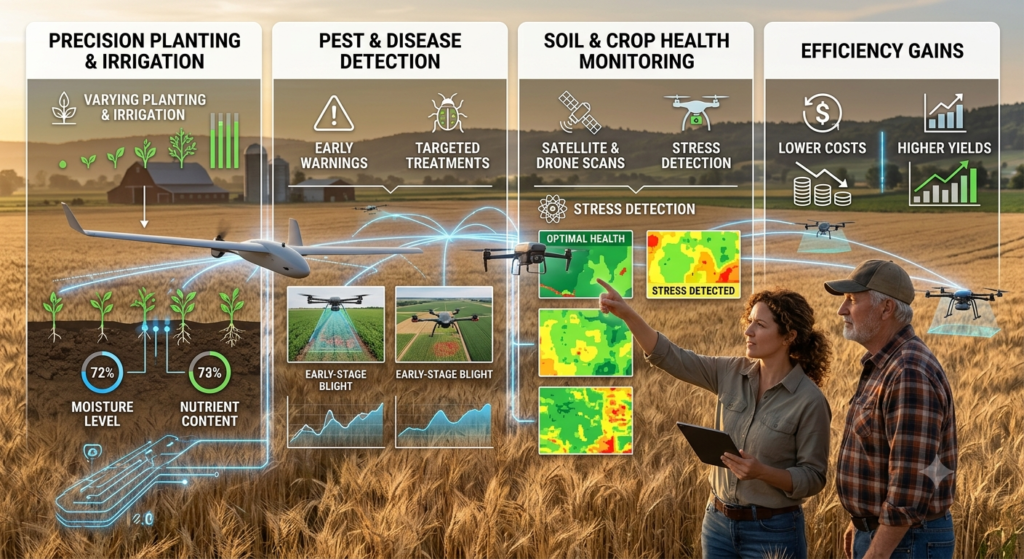
So what does this actually look like on the ground? How smart farming uses AI for better yields usually starts with data lots of it. Soil sensors track moisture and nutrient levels in real time. Satellite or drone imagery shows crop health across an entire field, catching stressed plants days before they’d be visible to the naked eye walking through the rows.
That data feeds into models trained to spot patterns humans would miss or catch too late. A slightly discolored section of a field might mean nothing to a farmer driving past at 40 mph, but a model trained on thousands of similar images flags it instantly as early-stage blight. Catch it early, and you might save the whole field. Catch it late, and, well, you know how that story usually ends.
Precision Planting and Irrigation
Precision planting is a pretty practical win here. Basically, you adjust seed spacing and depth based on how the soil varies across one field instead of treating the whole plot the same way which, honestly, is what most farms used to do by default, since there wasn’t really a better option. Irrigation works the same way now. Rather than soaking the whole field evenly, water gets sent specifically where it’s needed. Saves water, sure, but it also tends to boost yield in those drier patches that used to just… get left behind.
How Precision Agriculture Tools Boost Farm Efficiency
Okay, this is the part that actually moves the bottom line. Precision agriculture tools boost farm efficiency mostly by cutting waste using less water, less fertilizer, less pesticide, and using it smarter instead of just spraying everything across the board regardless of need. Less waste, lower costs. Lower costs, more of what the harvest is actually worth stays in the farmer’s pocket. Pretty straightforward, when you break it down.
Fertilizer’s a good example. Spray a whole field at one fixed rate and you’re ignoring that soil quality can swing wildly within a few hundred feet of itself. These tools map that variation out and adjust accordingly more where it’s actually needed, way less where it isn’t. Doesn’t sound like much per acre, but multiply it across a few hundred and the savings pile up quick.
Pest and Disease Detection
Pests don’t wait around, and by the time damage is visible to the eye, you’ve often already lost a chunk of the crop. Computer vision models trained on plant imagery can flag early signs of pest activity or disease sometimes a full week or two before a human would notice walking the rows. That head start is often the difference between a minor treatment and losing an entire section.
The Limits Nobody Talks About Enough
It’s not all smooth sailing. These systems need decent connectivity, and rural areas don’t always have it. Upfront costs for sensors and equipment can still be a real barrier for smaller operations. And data doesn’t replace a farmer’s judgment built from decades on the same land the best results come from combining both, not picking one over the other.
Conclusion
AI in agriculture isn’t replacing farmers if anything, it’s giving them sharper eyes and a bit more certainty in a job that’s always been full of unknowns. Smart farming technology and precision agriculture tools are cutting waste, catching problems earlier, and helping yields stretch further on the same acreage. None of it works without the people running the operation, but paired with decades of hands-on experience, this stuff is making a genuinely tough job a little more manageable. The farms adopting it now are likely setting themselves up well for whatever comes next.
FAQs
1. Is AI in agriculture only useful for large commercial farms? Not anymore. Costs have dropped enough that smaller and mid-sized farms can start with one tool, like a soil sensor, before scaling up.
2. How do AI models detect crop disease before it’s visible? They’re trained on huge sets of plant imagery and pick up on subtle color or texture changes well before the human eye would notice anything wrong.
3. Do precision agriculture tools actually save money? Generally, yes. By applying water, fertilizer, and pesticide only where needed instead of across an entire field, input costs drop noticeably over a season.
4. What’s the biggest challenge in adopting smart farming technology? Connectivity, mostly. A lot of rural areas still lack the reliable internet these systems depend on, which slows adoption in some regions.
5. Can AI completely replace traditional farming knowledge? No, and it’s not really designed to. The best results come from combining AI-driven data with the judgment farmers build over years on their own land.