A few years back, asking your phone to describe a photo felt like magic. Now it’s just Tuesday. What changed isn’t that computers got smarter overnight deep learning technology finally got good enough to do the heavy lifting quietly, every time you unlock your phone or ask a chatbot something.
So what’s actually going on under the hood? This guide covers what deep learning is, how neural networks work, and where you’ll run into it today without noticing.

What Is Deep Learning Technology?
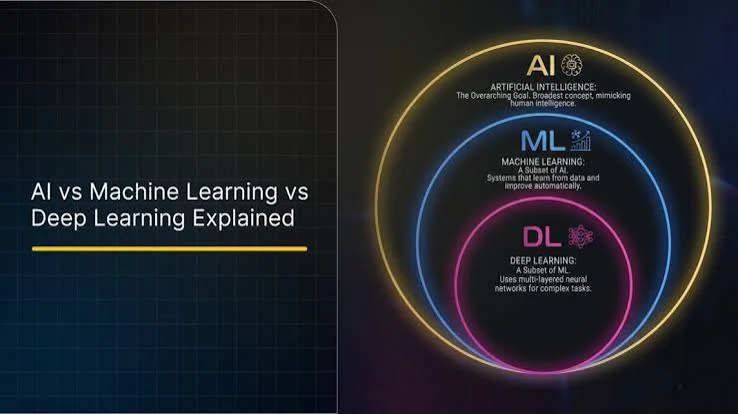
Deep learning is a type of machine learning that uses layered neural networks to dig through huge amounts of data, spot patterns, and then make predictions based on what it picked up. Image recognition, voice assistants, most AI tools you already use this is what’s running behind them.
Think of it as machine learning’s more ambitious cousin. Regular machine learning needs a human to point out which features matter, telling a spam filter which words look suspicious, for instance. In contrast, deep learning skips that, figuring out the patterns on its own, given enough examples.
However, that independence isn’t free. It needs a lot of data and a lot of computing power to get anywhere useful.
How Deep Learning Neural Networks Actually Work
At the center of all this sits the neural network loosely modeled on how neurons in the brain pass signals, though don’t take that comparison too far. It’s inspiration, not a blueprint.
Picture layers stacked one on top of another. Data goes in one end, works through layer after layer, and each layer notices something more complex than the one before. Feed it an image, and the first layer might catch edges. A few layers in, it picks out shapes. By the last layer, it knows it’s looking at a cat, a stop sign, a face.
How does it get there? Mostly trial and error. The network guesses, checks how far off it was, then nudges itself to do better next round. Do that across millions of examples, and accuracy climbs to a surprising level. On the ImageNet benchmark, image classification error rates using this approach have dropped below 5% outperforming most humans on the same test.

Key Features of Deep Learning Technology
A few things set this apart from older approaches. It learns features on its own instead of needing manual rules. As a result, it gets better as more data comes in, without a full redesign. It also handles messy, unstructured data, images, audio, and raw text far better than traditional software. On top of that, it runs efficiently on modern GPUs and AI chips built for this kind of math.
None of this is new in theory. What changed is that hardware finally caught up to the math, a big part of why deep learning went mainstream this decade.
Pros and Cons Worth Knowing
The upside is real. These models catch patterns a human eye would miss, adapt to new data without a full rebuild, and now power medical scans, fraud detection, and more with accuracy that holds up.
However, the downside gets less airtime. These things are data-hungry; a small dataset usually isn’t enough. Training gets expensive fast. On top of that, there’s the black-box problem: even the engineers who built the system can’t always explain why it made one call, which is a real issue in fields like healthcare or lending.
For a related look at where AI accuracy meets real business risk, our piece on AI in retail is worth a read.
Getting Started: Tools, Frameworks & Costs
Good news if you’re experimenting: the core frameworks won’t cost a thing. TensorFlow and PyTorch, the two most widely used deep learning libraries, are free to use. Where your money goes is compute training past a toy model, which means renting GPU time, and that bill scales fast as models grow.
Small projects run for a few dollars an hour on rented GPUs. Training at the scale of a modern language model can run into the millions. Most businesses never need to go there, since a pretrained model, fine-tuned on your own dataset, gets most of the value for a fraction of the cost.
For lighter-weight ways to get AI working without building from scratch, check our guide on no-code AI tools.
Real-World Applications of Deep Learning Today
Deep learning applications turn up in more places than people would guess. Healthcare uses it to read medical scans faster, sometimes more consistently than the human eye. Finance leans on it for fraud detection. Retailers use it for recommendation engines and visual search. Self-driving systems depend on it to recognize pedestrians, signs, and lane markings fast enough to matter.

What ties these together? Deep learning applications work best wherever there’s a mountain of data and patterns too subtle to code by hand.
Deep Learning vs. Machine Learning vs. Traditional Programming
| Feature | Traditional Programming | Machine Learning | Deep Learning |
| How it decides | Explicit human-written rules | Learns patterns from labeled data | Learns patterns via layered neural networks |
| Data needed | Minimal | Moderate | Large to massive |
| Feature selection | Manual | Partly manual | Automatic |
| Best for | Predictable, rule-based tasks | Structured data problems | Images, audio, unstructured data |
| Compute cost | Low | Moderate | High |
Alternatives and Related Approaches
Deep learning isn’t the only tool in the AI shed. For instance, simpler models decision trees, random forests, plain regression still outperform it on small, structured datasets and cost less to run. Similarly, rule-based systems still make sense when the logic is clear and doesn’t change much. The trick, therefore, is to match the tool to the problem, not to grab whatever sounds most impressive.
Curious how these ideas show up in business writing? Our guide on prompt engineering basics makes a good next stop.
FAQs
Is deep learning the same thing as AI? Not quite AI is the broad goal of building smart systems, and deep learning is one technique for getting there.
Do I need a powerful computer to try deep learning? Not for the basics. Small projects run fine on a regular laptop or a free cloud notebook. Serious training is where heavy hardware comes in.
How long does it take to train a deep learning model? Depends could be minutes or weeks, depending on model size and dataset. A simple image classifier can train in under an hour on modest hardware.
Verdict
Deep learning isn’t some distant future technology anymore. It’s already running behind your phone’s camera, your bank’s fraud alerts, whatever’s in your feed. Understanding how neural networks work makes it easier to tell where this genuinely helps versus where it’s just marketing dressed up as innovation. The frameworks are free, and the learning curve is more forgiving than it looks, so the best move is to start small and see what the models actually do.