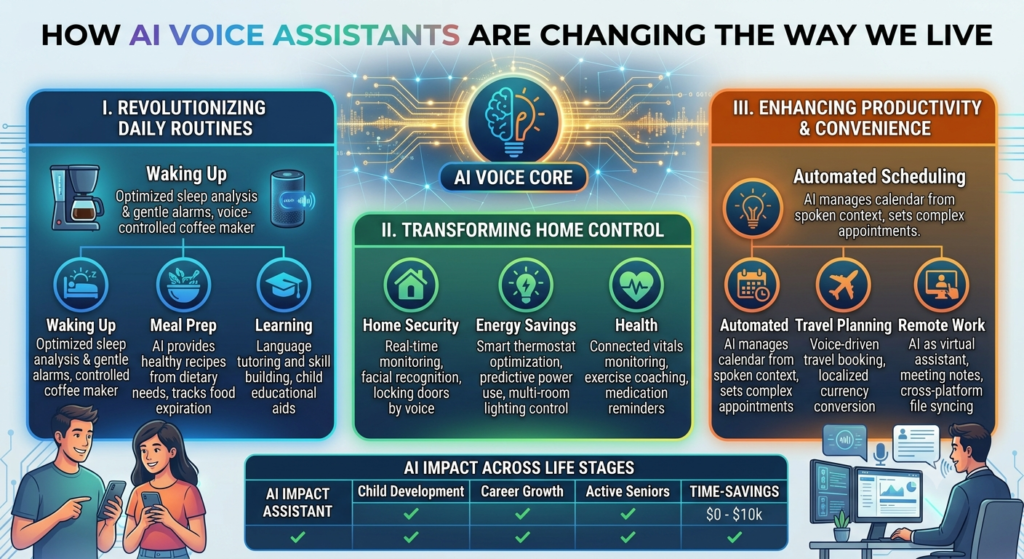
My hands were covered in flour last week when I asked my kitchen speaker to set a timer, and it just worked. No fumbling for a phone with sticky fingers. AI voice assistants have crept into daily life like that, quietly, one small favor at a time. What began as a party trick for checking the weather now runs households, gives directions, and helps people get through their workday. This piece walks through how these systems process your voice, where they genuinely help, where they still stumble, and how the biggest names stack up.
What Are AI Voice Assistants
AI voice assistants are software programs that use artificial intelligence to understand spoken language and turn it into a useful action. Think smart speakers, phones, cars, anything you can talk to instead of typing at.
Under the hood, though, it is not simple at all. You have natural language processing stacked on machine learning models, trained on mountains of speech data collected from real people talking in real ways. Amazon Alexa, Google Assistant, Apple Siri, and Samsung Bixby are the names most people already know, and each company takes its own swing at accuracy and personalization, which is why one assistant can feel sharp and another can feel a step behind. Our guide on no-code AI tools for small businesses gets into how this same tech powers everyday business automation too.
How AI Voice Assistants Understand Speech
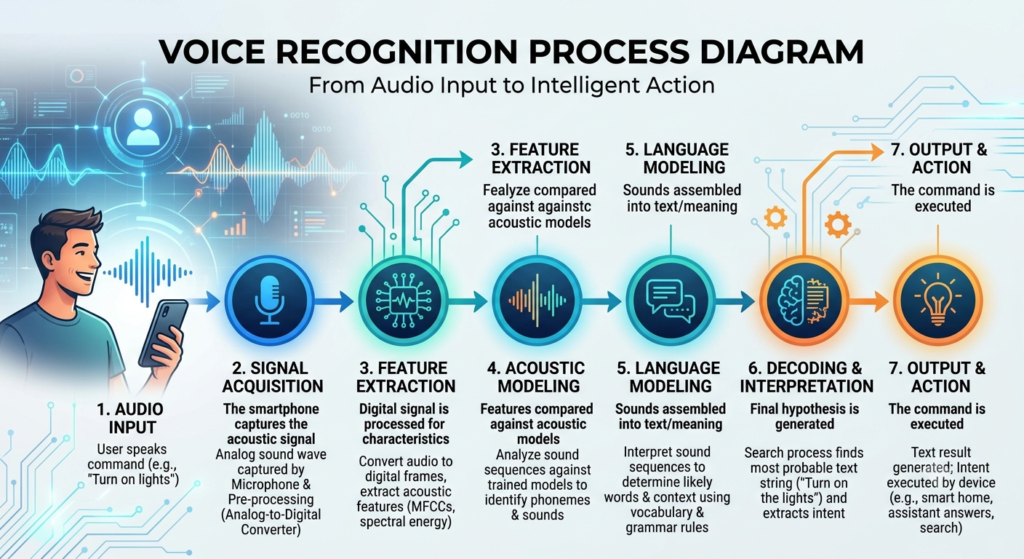
Voice recognition technology converts sound waves into text, then uses AI models to interpret meaning and generate a response within a second or two.
Here is the short version. Your microphone captures your voice and turns it into a digital audio signal, broken into tiny segments. An acoustic model matches those segments to phonemes, the basic building blocks of speech, and a language model predicts the most likely sequence of words based on context. That is how your assistant tells the difference between “recognize speech” and “wreck a nice beach.” The National Institute of Standards and Technology has tracked steady gains in speech recognition accuracy over the past decade, thanks to deep learning replacing older methods.
Key Features of Modern Voice Assistants
Today’s assistants do more than answer trivia now. You can ask a follow-up question without repeating the whole request, since most models remember what you just said and carry that context into the next reply. A lot of people never touch that feature and just use routines instead, one phrase that fires off a whole chain of actions, like dimming the lights and locking the door at bedtime. Accents used to trip these systems up constantly, and background noise made things worse, but that has quietly improved over the past few years.
The bigger shift might be how far smart speaker tech has spread into the rest of the house. A single sentence can now reach a thermostat, a lock, a camera, and a handful of appliances at once, and some households set up separate voice profiles so the system treats one person’s request differently from another’s, which matters more than it sounds like once you have kids in the house.
Pros and Cons
There is plenty to like, but the technology is not perfect.
On the upside, voice assistants save time on daily tasks, offer hands-free convenience while cooking or driving, and support accessibility for people with visual impairments or limited mobility. They also learn your habits over time.
On the downside, privacy remains a real concern since these devices are always listening for a wake word. Accuracy can dip in noisy environments or with strong accents, and compatibility between ecosystems is inconsistent. Our breakdown of AI automation tools for daily productivity covers more.
Popular AI Voice Assistants and Their Pricing
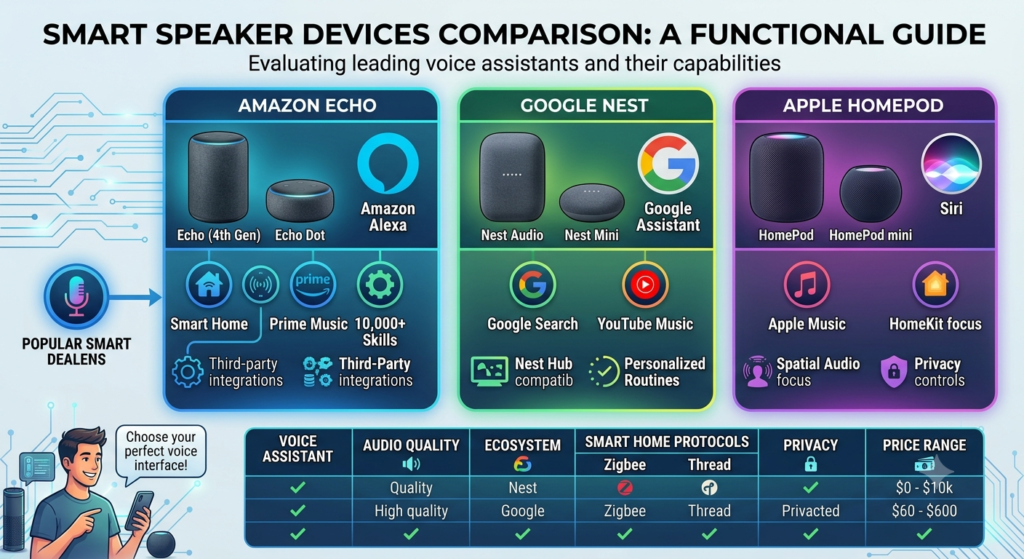
You do not need a big budget to start. Amazon Alexa comes free with any Echo device, and Echo Dots often go on sale for under fifty dollars. Google Assistant works on Nest speakers at a similar price and ships free on most Android phones. Apple Siri comes free with every iPhone and HomePod, and Bixby ships free on Galaxy devices. The real cost usually comes from the gadgets you connect.
Best Use Cases
Voice assistants shine in a handful of everyday situations. Cooking is an obvious one, since setting timers hands-free saves real hassle. Commuting is another, with voice-controlled navigation keeping drivers focused on the road. Parents lean on routines for bedtime schedules, and small business owners have started pairing voice commands with automation platforms to log tasks without touching a keyboard, a trend our piece on marketing AI tools for small teams covers.
Comparison Table
| Assistant | Best For | Free Tier | Smart Home Support | Accuracy Rating |
| Amazon Alexa | Smart home control | Yes | Extensive | 4.5 out of 5 |
| Google Assistant | General search and Android integration | Yes | Strong | 4.6 out of 5 |
| Apple Siri | Apple ecosystem users | Yes | Moderate | 4.2 out of 5 |
| Samsung Bixby | Galaxy device owners | Yes | Growing | 3.9 out of 5 |
Alternatives Worth Knowing
A few newer players are pushing voice AI in interesting directions. Amazon’s generative Alexa features aim for more natural conversations, and Microsoft has folded voice into Copilot for productivity. Smaller startups are building privacy-first assistants that process voice data on the device instead of the cloud, an approach our earlier piece on prompt engineering and AI privacy practices explores. None have overtaken the big four.
Frequently Asked Questions
How do smart speakers use AI to understand commands? A wake word detector listens locally for a trigger phrase like “Alexa” or “Hey Google.” Once triggered, cloud-based AI processes the command, usually within a second or two.
How does voice recognition technology work in AI? Sound gets captured, converted to digital data, broken into phonemes, matched against language patterns, and translated into an action. Companies keep refining these models with diverse data so they understand a wider range of voices.
Are voice assistants always listening? Devices listen locally for the wake word only. Audio is not sent to company servers until detected, and users can review or delete recordings through the app.
Can voice assistants work without internet? Basic commands like timers can sometimes work offline, but most advanced requests need a connection since heavy processing happens in the cloud.
Verdict
AI voice assistants have moved from a gadget trick to genuinely useful tools that save time across cooking, driving, parenting, and small business tasks. Amazon Alexa and Google Assistant lead on smart home flexibility, while Siri remains the natural pick for Apple users. If privacy is a worry, watch for newer on-device processing options. Start small with one speaker before wiring your whole home into a single system.