
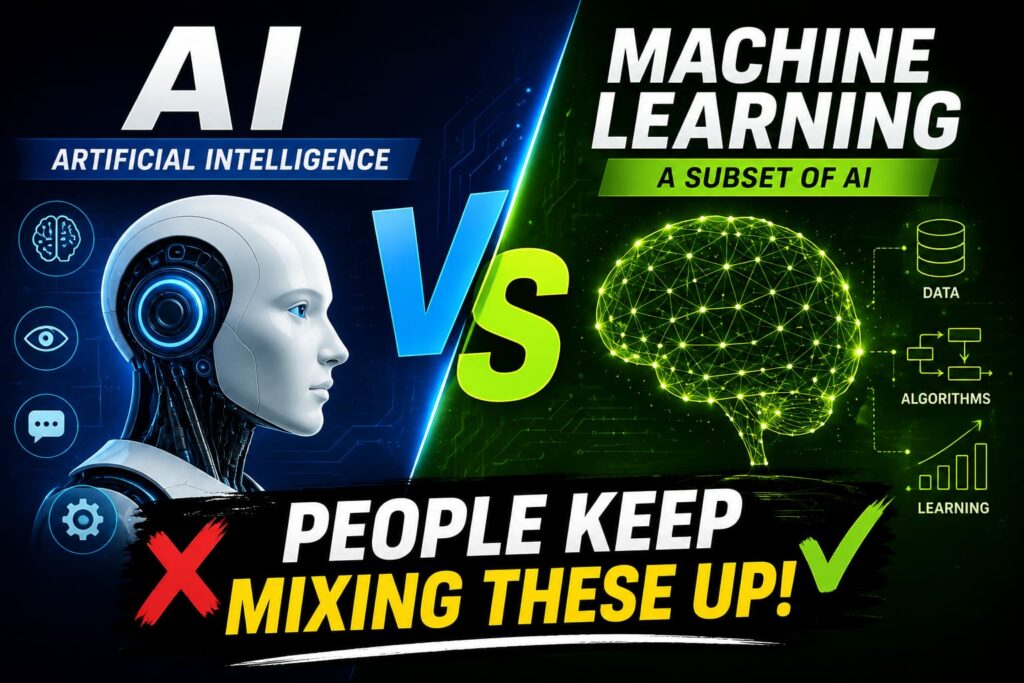
I’ve lost count of how many conversations I’ve been in where someone says “AI” and means machine learning, or says “machine learning” and actually means AI in general. It’s not really their fault. The two get thrown around so loosely in marketing and news headlines that most people never got a clean explanation of where one stops and the other starts.
So let’s just clear it up.
The Short Version
AI is the big idea. Machine learning is one way of actually building it.
That’s really it. Artificial intelligence is the umbrella term for machines doing things that normally need human-level thinking understanding language, recognizing a face in a photo, deciding what move to make next. Machine learning is a specific technique under that umbrella, where instead of writing out every single rule by hand, you feed the system a pile of data and let it figure out the patterns itself.
Here’s the part that trips people up though: every machine learning system counts as AI, but not every AI system uses machine learning. Old-school AI think of a basic chess program from the 90s ran entirely on hardcoded rules. No learning involved. Just “if this, then that,” repeated a few million times.
A Table, Because Sometimes That’s Just Easier to Read
| AI | Machine Learning | |
|---|---|---|
| What it is | The broad goal machines acting “smart” | One method for reaching that goal |
| How it works | Rules, logic, learning, or some combination | Learns patterns from data instead of fixed rules |
| Needs training data? | Not necessarily | Basically always |
| Gets better with use? | Only if it has a learning piece built in | Yes that’s the entire point of it |
| Real example | A chatbot with scripted answers | A spam filter that adapts as it sees more emails |
Why This Keeps Confusing People
Honestly? Because the AI tools most of us actually use Claude, ChatGPT, whatever recommends your next Netflix show are all built on machine learning under the hood. Specifically a flavor of it called deep learning. So when someone says “this app uses AI,” what’s actually happening is a machine learning model, trained on a mountain of data, is doing the work.
There’s a third term worth throwing in here too, since it comes up constantly:
Deep learning sits inside machine learning. It’s the version that uses layered neural networks loosely modeled on how neurons connect in a brain and it’s what’s behind basically every chatbot and image-recognition tool you’ve heard of. IBM’s breakdown of AI concepts puts it pretty plainly too: machine learning is one approach among several used to build AI, not a synonym for it.
So the nesting goes: AI → machine learning → deep learning. Each one is a smaller, more specific slice of the one before it.
Examples That Actually Make It Click
Forget the definitions for a second. Here’s what this looks like in real life:
Your old thermostat that kicks the AC on past 75 degrees? That’s rule-based AI. Technically “smart,” but it’s not learning anything, ever. It’ll do the same thing in ten years that it does today.
Netflix figuring out you like slow-burn thrillers after you watch three of them in a row? That’s machine learning. It’s noticing patterns in your behavior and adjusting.
Something like Claude, writing this article, generating an answer based on context it’s picked up from huge amounts of training data? Deep learning machine learning’s more powerful, more data-hungry cousin.

Does the Difference Actually Matter, or Is This Just Semantics?
I’d argue it matters more than people give it credit for, especially if you’re working in tech or hiring for it. Telling someone “I want to build an AI system” doesn’t really say much building a scripted chatbot and training a machine learning model on customer data are two completely different jobs. Different skills, different timelines, different everything.
It changes expectations too. A machine learning system needs data, sometimes a lot of it, and it gets better slowly, as it sees more examples over time. A rule-based system doesn’t improve unless a human manually rewrites the rules. If you’re planning a project and you don’t know which one you’re actually building, you’re going to run into trouble down the line not because the tech failed, but because nobody set the right expectations upfront.
Want to go deeper into the mechanics of how these models actually get trained? We’ve got a guide to how machine learning models work that walks through it step by step.
Where I’d Leave This
AI is the destination. Machine learning is one of the main roads that gets you there arguably the most important one right now, since it’s what powers almost everything people call “AI” today. Once that distinction clicks, most of the buzzword confusion around this whole space starts to make a lot more sense.
FAQs
Is machine learning basically the same thing as AI? Not exactly. It’s a method used to build AI, not a stand-in word for it. AI is the broader concept; machine learning is one way of achieving it.
Can something be AI without using machine learning at all? Yeah, actually. Older rule-based systems fixed-logic programs, basic automation count as AI even though they never learn from data.
Is deep learning just another name for machine learning? No, it’s more specific. Deep learning is a subset of machine learning that uses neural networks, and it’s what’s running behind most modern AI tools you’d recognize by name.
If I want to get into this field, where should I actually start? Get comfortable with general AI concepts first, then move into machine learning specifically once you’re ready to build or train models that’s where most of the hands-on work actually happens.
Do most AI apps today rely on machine learning? Pretty much all the ones you’ve heard of, yeah especially anything dealing with language or images. Simpler rule-based tools still exist, just not in the spotlight anymore.