
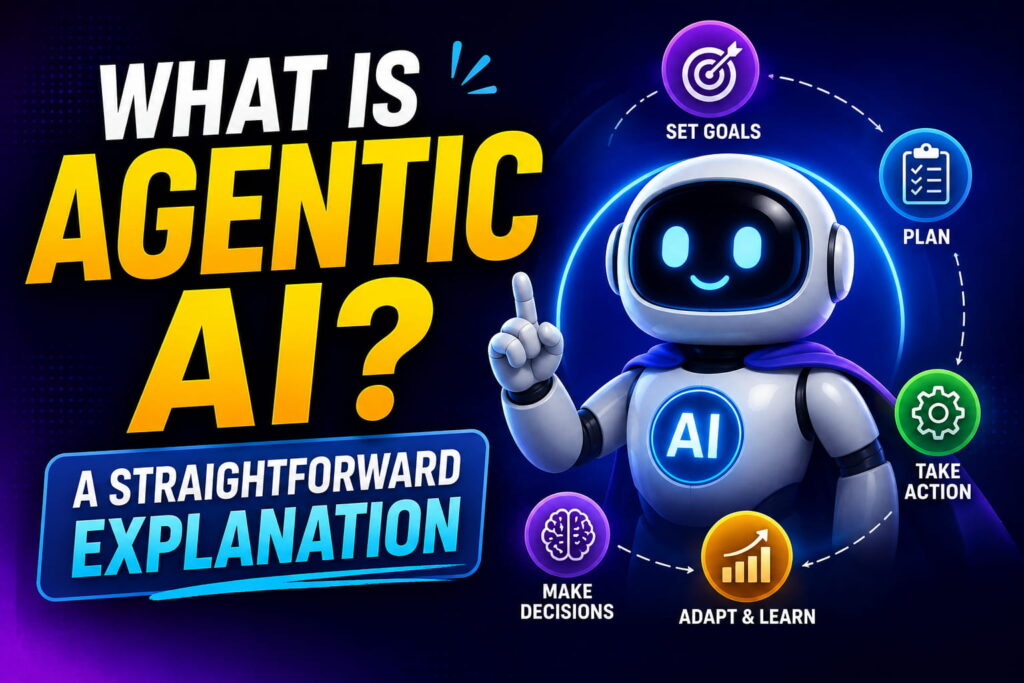
“Agentic AI” is one of those terms that started showing up everywhere almost overnight in product launches, LinkedIn posts, tech news headlines and half the time it’s used so loosely you’d think it just means “AI, but fancier.” It doesn’t. There’s an actual, specific idea behind it, and once you get it, a lot of the current AI hype starts making more sense.
So let’s actually break it down.
What Agentic AI Actually Means
Agentic AI refers to AI systems that can act on their own to complete a goal, not just respond to a single prompt and stop. Instead of you asking a question and getting one answer back, an agentic system can plan out steps, use tools, make decisions along the way, and keep working toward a bigger outcome often without you checking in after every single move.
The word “agentic” comes from “agency” the ability to act independently. That’s really the whole distinction. A regular chatbot waits for your next message. An agentic system can figure out what needs to happen next on its own.
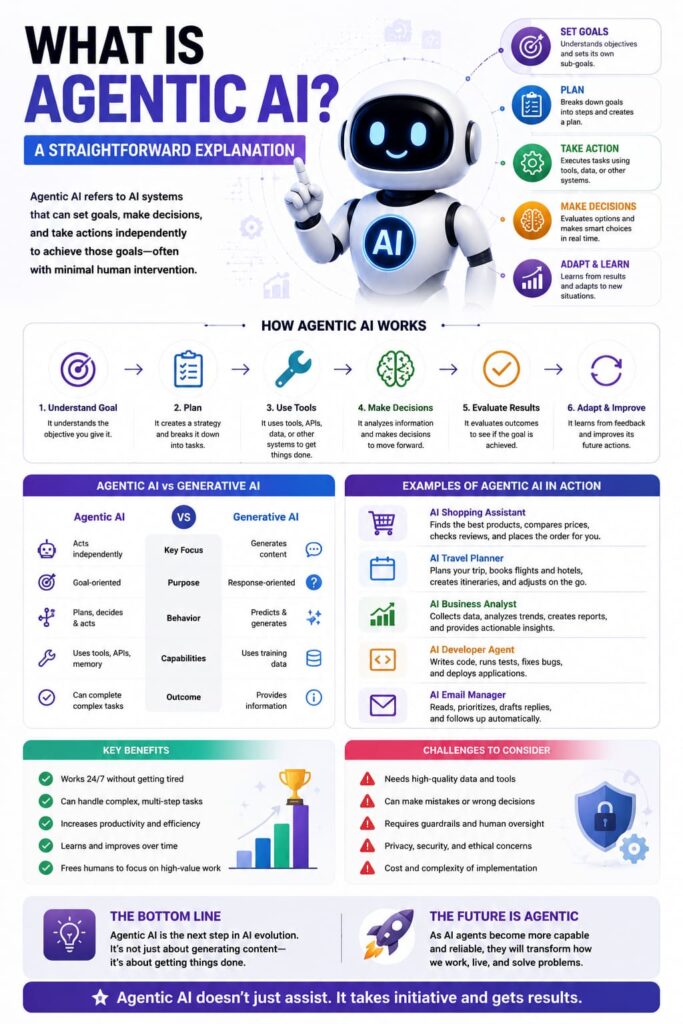
How It’s Different From a Regular Chatbot or AI Tool
Here’s where most of the confusion comes from, because on the surface, agentic AI and a normal chatbot can look pretty similar both talk to you, both use language models underneath. The difference shows up in what happens after you give it a task.
| Regular AI Chatbot | Agentic AI | |
|---|---|---|
| Handles one request at a time | Yes, typically | No it can chain multiple steps together |
| Uses external tools on its own | Rarely, unless explicitly triggered | Often, like searching, running code, or calling an API |
| Needs a prompt for every action | Yes | No it can decide the next action itself |
| Works toward a longer-term goal | Not really, one-off answers | Yes, that’s the core idea |
| Example | Asking for a summary of an article | Asking it to research a topic, draft a report, and email it to someone |
A Real Example Makes This Easier to Picture
Say you ask a regular AI tool, “What’s a good marketing strategy for a small coffee shop?” It gives you an answer, and that’s it. You’re the one who has to take that answer and actually do something with it.
Now say you’re using an agentic AI system and you tell it, “Research marketing strategies for small coffee shops, put together a plan, and draft social media posts for the first month.” An agentic system would break that down into steps on its own search for relevant information, pull together ideas, structure a plan, write the posts without you having to prompt it after every single step.
That’s the shift. It’s not just answering it’s doing, across multiple steps, toward a goal you gave it once.
Why This Is Suddenly Such a Big Deal
Part of it is that language models finally got good enough to reason through multi-step tasks reliably, instead of falling apart after two or three steps. Anthropic’s own writing on agentic systems touches on this the idea that AI models are increasingly capable of using tools and taking actions in a loop, not just generating a single response.
This matters practically because a lot of real work isn’t a single question with a single answer. Research, coding, customer support, scheduling these all involve multiple steps, decisions along the way, and often some back-and-forth. Agentic AI is an attempt to actually handle that whole chain, not just the first step of it.
Where It’s Actually Being Used Right Now
- Coding assistants that don’t just suggest a line of code but can write, test, and debug across an entire project
- Customer support agents that can look up an order, process a return, and send a confirmation, all without a human stepping in
- Research tools that go out, gather information from multiple sources, and compile it into something usable
- Scheduling and workflow tools that coordinate calendars, send follow-ups, and handle logistics on their own
The Catch Because There’s Always One
Agentic AI sounds great on paper, but giving a system more autonomy also means more room for it to go wrong in ways you didn’t expect. If it’s making decisions across multiple steps without checking in, a small mistake early on can snowball by the time it reaches the end. That’s why most agentic systems today still include some kind of human checkpoint a review step, a confirmation before anything irreversible happens, that sort of thing.
It’s also worth knowing the difference between agentic AI and simple automation, since people conflate them a lot. If you want to go deeper on that distinction, check out our guide to AI automation vs agentic systems for a more detailed comparison.
Bottom Line
Agentic AI isn’t just a buzzword for “AI that’s smarter” it specifically means AI that can plan, use tools, and carry out multi-step tasks toward a goal, mostly on its own. Regular chatbots answer; agentic systems act. As the underlying models keep improving, expect this to show up in more everyday tools, from coding to customer service to research just don’t expect it to work perfectly without any oversight, at least not yet.
FAQs
Is agentic AI the same thing as a chatbot? No. A chatbot typically answers one prompt at a time. Agentic AI can plan out and complete multiple steps toward a goal without needing a new prompt after each one.
What makes an AI system “agentic”? The ability to act with some independence deciding what to do next, using tools on its own, and working toward a broader goal instead of just answering a single question.
Is agentic AI the same as automation? Not quite. Traditional automation follows fixed, pre-set steps. Agentic AI can make decisions along the way and adjust based on what it encounters, rather than following a rigid script.
Where is agentic AI already being used? Coding assistants, customer support tools, research assistants, and workflow or scheduling tools are some of the more common places it shows up right now.
Is agentic AI safe to use without supervision? Generally, no most systems still include some kind of checkpoint or human review, especially for anything with real consequences, since letting AI act fully independently still carries risk.