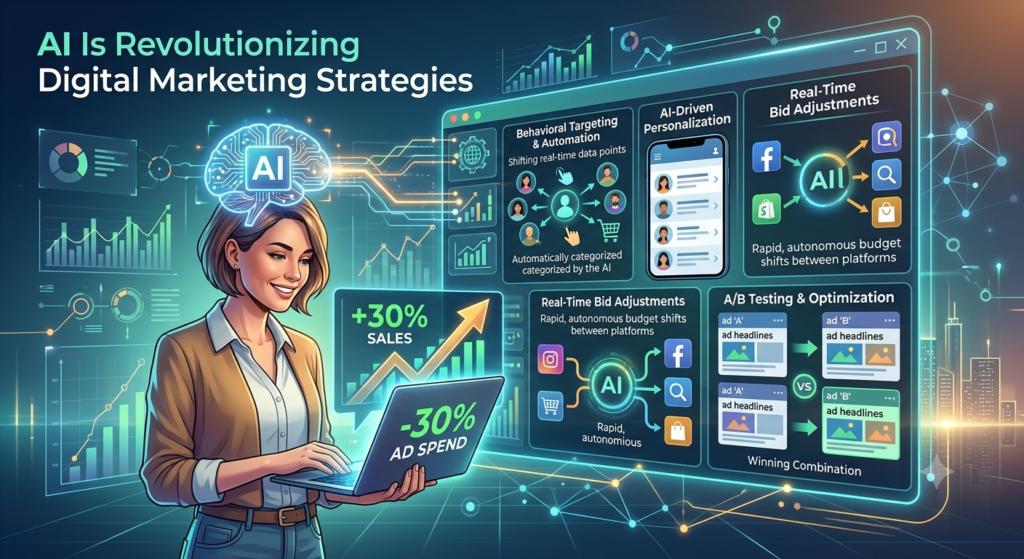
A friend of mine runs a small online store, and last month she told me her ad spend dropped almost thirty percent while sales actually went up. Her secret wasn’t some genius new strategy she dreamed up at 2 AM. It was AI quietly handling the targeting, the timing, the testing all the stuff that used to take her entire weekend.
That’s basically where digital marketing has landed these days. AI in marketing isn’t some future trend anymore; it’s already running in the background of most campaigns you scroll past without noticing. So what’s actually changed, and why does it matter for businesses trying to keep up?
Why Marketing Needed This Shift
Honestly, half of old-school marketing was just guesswork, wearing a nice suit. You’d pick an audience based on rough hunches, run an ad, wait around a week, then squint at the numbers, trying to piece together what actually worked. By the time anything got adjusted, the moment had usually already slipped past.
There’s also the sheer scale problem. Modern platforms generate mountains of data clicks, scroll depth, time spent, abandoned carts way more than any marketing team could realistically sift through by hand. Humans are good at creative thinking, but terrible at processing that volume of behavioral data fast enough to act on it in real time.
That gap is exactly where AI found its opening, and honestly, it didn’t take long to take over.
How AI Marketing Automation Actually Works
Have you ever noticed an ad show up that seemed to know what you wanted before you’d even searched for it? Not a coincidence, not magic either that’s AI marketing automation running behavioral patterns across thousands, sometimes millions, of similar users and predicting what’s likely to land.
These systems handle the repetitive grunt work, too. Scheduling posts, A/B testing headlines, adjusting bids on ad auctions in real time, sorting leads by likelihood to convert stuff that used to eat up hours of a marketer’s week now runs largely on its own. The system learns from results constantly, tweaking campaigns mid-flight instead of waiting for a weekly report to spot what’s underperforming.
What’s genuinely useful here is the speed. A human team reviewing campaign performance might catch an underperforming ad after a few days. AI flags it within hours, sometimes minutes, and can shift budget toward what’s actually working without anyone needing to manually intervene.
AI-Driven Personalization in Action
Here’s where things get a little more interesting, honestly personalization used to mean inserting someone’s first name into an email subject line and calling it a day. AI-driven personalization goes far beyond that now.
Picture browsing an online store, leaving without buying anything, and then getting an email later that day showing the exact items you looked at, maybe with a small nudge like a discount. That’s not random. The system tracked your behavior, built a profile around your interests, and tailored the follow-up specifically for you, not for some broad audience segment you happen to fall into.
Streaming platforms, retailers, and even news apps lean on this constantly. Recommendations feel eerily accurate sometimes because the underlying model has learned your patterns well enough to predict what you’ll probably click next. It’s a little unsettling if you think about it too hard, but it’s also genuinely effective.
How AI Automation Improves Marketing Campaigns
Honestly, the efficiency gains here are hard to overstate. A campaign that used to need someone babysitting it constantly now mostly runs on its own, which means marketers can actually spend their time on strategy and creative work instead of staring at spreadsheets all day.
Budget allocation gets smarter, too. Instead of splitting ad spend evenly across channels and hoping for the best, AI shifts money toward whatever’s converting in real time, pulling it away from channels that are quietly underperforming. That alone can meaningfully change return on investment without anyone touching a single setting manually.
There’s also a testing angle worth mentioning. AI can run dozens of ad variations simultaneously, something that would take a human team weeks to test manually one version at a time. The winning combination gets identified fast, and the losing ones get phased out before they burn through much budget.
How AI Personalizes Marketing for Customers
Step back from the technical stuff for a second, because something bigger is happening in how customers actually experience marketing now. Nobody wants the same generic blast everyone else on the list is getting and increasingly, they’re not stuck with it either. Content shows up shaped around what someone actually cares about, what they’ve browsed, and what they’ll probably need next.
This shows up in subtle ways too website content that rearranges itself based on a visitor’s past behavior, product recommendations that genuinely feel relevant instead of random, even chatbots that adjust their tone depending on whether someone seems frustrated or just casually browsing.
For businesses, this kind of personalization tends to build loyalty in a way that generic marketing rarely manages. Customers respond better to feeling seen rather than feeling targeted, even if the underlying mechanism is, technically, the exact same thing.
Where AI in Marketing Still Falls Short
None of this is flawless, and it’s worth saying plainly. Get too aggressive with personalization, and it starts feeling invasive fast somewhere between “oh nice, helpful suggestion” and “wait, how do they know that” sits a line, and plenty of brands accidentally cross it. Brands that misjudge that line risk alienating the very customers they’re trying to win over.
There’s also the creative gap. AI can optimize and predict extremely well, but it still struggles with genuinely original ideas, the kind of campaign that breaks convention rather than refining what’s already working. That spark still needs a human behind it, at least for now.
Conclusion
A nice-to-have experiment. That’s basically what AI in marketing used to be, and now it’s closer to a baseline expectation across the whole industry pretty quick turnaround, honestly. Automating the repetitive grind, personalizing experiences at a scale no human team could pull off manually, it’s reshaped both how campaigns get built and how customers experience brands. Not perfect, and creative direction still needs a human hand, but modern digital marketing without it? Hard to picture at this point.
FAQs
1. Can AI completely replace human marketers? Nah, not really. Automation, data analysis, personalization AI’s great at all that. But genuinely original campaign ideas and creative strategy? That still needs a human in the room.
2. How does AI marketing automation actually save time? It handles repetitive tasks like scheduling, bid adjustments, and A/B testing automatically, freeing marketers to focus on strategy instead of manual, repetitive campaign management.
3. Is AI-driven personalization the same as basic email personalization? No, it goes much further. It’s based on ongoing behavioral data and builds tailored experiences continuously, rather than just inserting a name into a template.
4. Can small businesses afford AI marketing tools? Yes, increasingly so. Many affordable, even free-tier, tools now offer automation and personalization features that used to require enterprise-level budgets.