
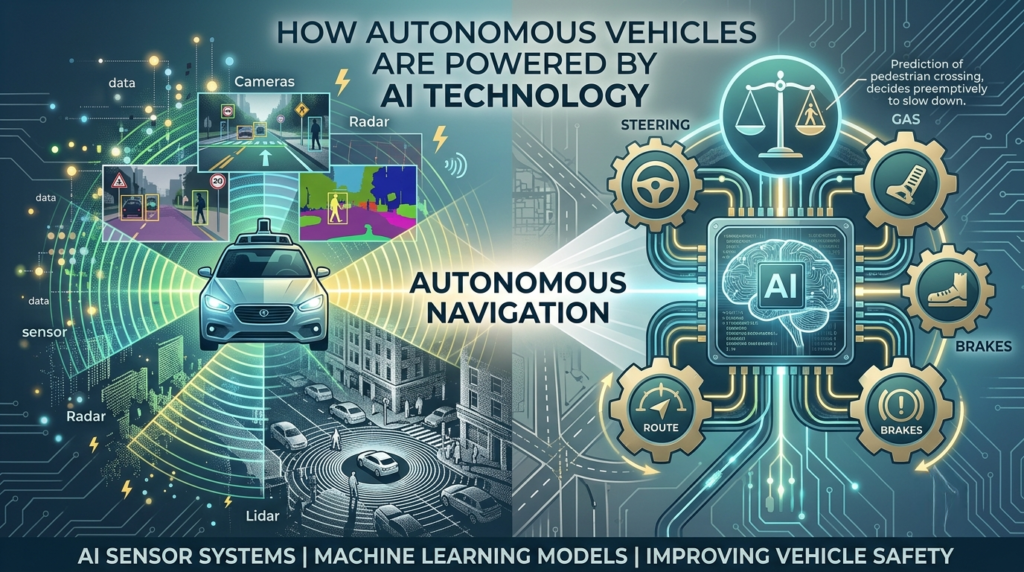
My uncle still doesn’t trust cruise control, let alone a car that drives itself. Fair enough a two-ton machine making split-second decisions without a hand on the wheel sounds unsettling the first time you hear it. Peel back the layers, though, and it’s less magic, more a pile of cameras, sensors, and clever math working together faster than any human reaction time.
Autonomous vehicles aren’t some far-off concept anymore. They’re logging millions of test miles, running pilot programs in several cities, slowly working into how people think about getting around. So what’s actually happening inside one of these things?
What Makes a Vehicle Truly Autonomous
There’s a scale here, not a switch. Lane-keeping, adaptive cruise control plenty of cars already do this, but it’s a far cry from full autonomy. Going fully driverless means the car handles its own steering, gas, brakes, and route, nobody touching anything at least within whatever conditions the system’s built to handle.
Engineers talk about this in levels, ranging from basic assistance up to full autonomy, where no human input is needed at all, even leaving the driver’s seat optional. Most vehicles people interact with today sit somewhere in the middle.
Getting from assisted driving to true autonomy isn’t about adding features one by one. It’s about building systems reliable enough to handle situations nobody specifically programmed for a kid chasing a ball into the street, a sudden downpour, construction crews waving traffic through by hand. That unpredictability is the hard part.
How AI Sensor Systems Build a Picture of the Road
Cars don’t have two eyes and a brain figuring things out the way we do. What they’ve got instead is a dozen-plus data feeds running simultaneously, which is basically the whole job of an AI sensor system stitch it all into one coherent read on the road.
Cameras capture visual data lane markings, traffic signs, pedestrians, other vehicles. Radar bounces signals off objects to judge distance and speed, working reasonably well even in poor visibility. And lidar that one fires out laser pulses in every direction, piecing together a 3D map of everything nearby dozens of times a second.
None of these sensors work alone, and that’s the point. Each has weaknesses that the others compensate for. Cameras struggle in fog. Radar isn’t great at reading text on a sign. Lidar can get fooled by certain weather, too. Combine them, cross-reference what each reports, and you get something far more reliable than any single source could deliver alone.
How Self-Driving Cars Use AI to Navigate
None of that sensor data does anything by itself, though something still has to actually make sense of it. The AI handles that part. Machine learning models work through the incoming stream nonstop, spotting what’s around, guessing where it’s headed next, and landing on the right move all in a fraction of a second.
Here’s an example. A pedestrian steps toward a crosswalk ahead. The system doesn’t just see a person it estimates their trajectory, factors in how fast they’re moving, considers whether they’re looking at their phone or watching traffic, and decides whether to slow down preemptively or maintain speed.
This decision-making gets trained on enormous amounts of driving data, including edge cases collected specifically because they’re rare and tricky. The more unusual scenarios a system’s trained on, the better it tends to handle situations nobody anticipated when the software was first written.
Mapping plays a role too. Many self-driving systems rely on extremely detailed maps, far more precise than a regular GPS app provides, giving the vehicle a baseline understanding of the road before relying purely on real-time sensor input.
How AI Sensors Improve Vehicle Safety
The safety case here is where things get interesting. Human drivers get distracted, tired, or react a beat too slow. Sensor systems don’t blink, don’t check a phone, and process information at a speed unavailable to a human nervous system.
Collision avoidance systems can detect a hazard and start braking before a driver would’ve consciously registered the danger. Blind-spot monitoring catches vehicles that a human might miss in a quick mirror check. Some systems even monitor driver attentiveness in semi-autonomous setups, stepping in if someone’s drifted out of their lane.
That said, none of this makes autonomous vehicles flawless. Sensor systems can still get confused by unusual lighting, heavy snow burying lane markings, or genuinely bizarre situations nobody trained the model on. Safety improves dramatically, but it’s not the same as eliminating risk.
The Real Challenges Holding Full Autonomy Back
Forget the technology for a second trust is the part that’s actually proving stubborn. People feel safer behind their own wheel, statistics or no statistics, and that gut feeling alone slows public acceptance down no matter how solid the underlying tech actually gets.
Regulation hasn’t caught up evenly either. Rules vary between regions, and liability questions get messy fast who’s responsible if an autonomous vehicle causes an accident, the manufacturer, the software developer, someone else? Still being sorted out in courtrooms and legislatures, with no universal answer yet.
Then there’s the genuinely hard technical stuff. Most edge cases get handled fine now, but rare, bizarre scenarios still trip up even well-trained systems occasionally. Closing that last gap is proving slower than early predictions assumed.
Conclusion
Layers, basically that’s what’s keeping an autonomous vehicle on the road. Sensors, real-time processing, machine learning models trained on a mountain of driving data, all of it working together to handle decisions that used to need a human behind the wheel. AI sensor systems keep a constant, detailed read on what’s happening outside the car, while self-driving car technology turns that information into split-second calls most people would struggle to match. Not flawless yet, and trust, along with regulation, still has real catching up to do, but the underlying capability keeps improving steadily, year over year.
FAQs
1. What’s the real difference between driver-assist tech and full self-driving? Driver-assist handles bits and pieces staying in a lane, adjusting speed but full autonomy means the car runs the whole show: steering, braking, navigation, no hands needed, within whatever conditions it’s built for.
2. Why do autonomous vehicles use multiple types of sensors instead of just one? Each sensor type has weaknesses, so combining cameras, radar, and lidar lets the system cross-check information and build a more reliable picture of the road.
3. Are autonomous vehicles actually safer than human drivers? Often, yes sensors react quicker and don’t get distracted by a phone buzzing. They’re not perfect, though, and stuff like heavy snow can still throw them off.
4. What’s preventing fully autonomous cars from being everywhere already? A mix of unresolved regulation, liability questions, public trust issues, and rare edge-case scenarios that still challenge even well-trained systems.
5. How does AI help a self-driving car make decisions in real time? Machine learning models process sensor data continuously, identifying objects and predicting their movement to decide what action the vehicle should take next, all within fractions of a second.