
So my cousin works at a regional bank, in the fraud department, and she told me something a while back that stuck with me. Her team used to spend entire mornings going through flagged transactions one by one most turned out to be completely fine. Nowadays, half that work is already done before she’s even logged in for the day.
That’s basically the whole story of AI in finance in one anecdote. Banking has always run on numbers. What’s different now is how fast those numbers get crunched. Stuff that used to take days loan approvals, flagging a sketchy wire transfer, shifting a trading position can happen in the time it takes you to blink. Give or take.
But why now? What pushed things this far, this fast?
Why Banks Couldn’t Keep Doing Things the Old Way
Banks have always had insane amounts of data lying around. What changed is that the scale outgrew what any team of humans could realistically review. Millions of transactions every minute across global markets double your fraud team, and you still won’t scratch the surface manually.
Then there’s the speed issue, unique to finance. Markets don’t pause for lunch. Fraud doesn’t wait for tomorrow’s meeting. Catch a problem a day late, and the money’s usually gone. Customers have gotten impatient too nobody wants a three-day wait for a loan when some app approves it in ten minutes.
Add regulators demanding tighter compliance, and banks were backed into a corner. AI happened to be sitting right there, ready to fill that gap.
What’s Actually Happening With AI Fraud Detection in Finance
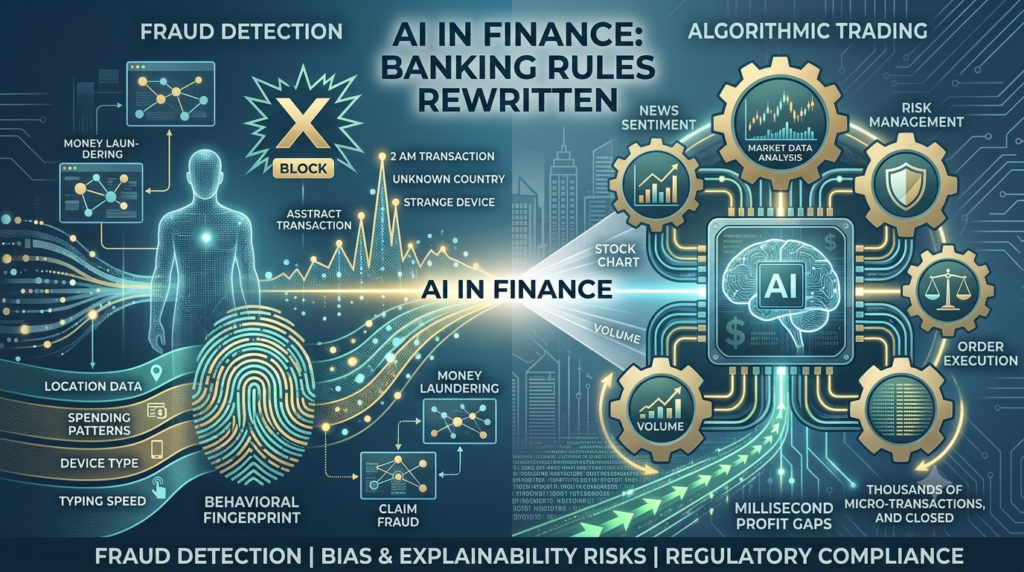
Picture this someone steals a card and uses it at 2 AM, in a country the real cardholder’s never set foot in. A human reviewer might eventually catch that, maybe a day or two later, once the customer notices their statement and calls in, annoyed.
AI fraud detection finance systems catch it almost instantly. Why? Because they’ve already built a behavioral fingerprint of how that person normally spends where, when, how much, even how they type their card number at checkout. So when a transaction veers wildly off that pattern, the system flags it, sometimes blocks it, often before the money’s even moved.
Is it perfect? Not even close. False positives happen all the time plenty of people have had a legit purchase declined just because it looked “off” to the algorithm. Annoying, sure. But weigh that against letting real fraud slide through, and most banks take the occasional false alarm every time.
How Banks Use AI to Detect Financial Fraud Beyond Just Cards
Cards get all the headlines, but that’s just the surface layer. Underneath, there’s money laundering detection individual accounts that look normal on their own, but connect the dots across dozens of accounts and a completely different story forms.
Insurance divisions inside bigger banks run similar models, catching fraudulent claims by spotting patterns no single reviewer could notice across thousands of claims a month. Account takeovers get caught this way too odd login locations, sudden device changes, password resets that don’t match usual behavior, all cross-checked automatically in real time.
The most useful part? These systems keep learning. Fraudsters don’t sit still, so a model that evolves with them outlasts the old rule-based setups someone had to manually rewrite every few months.
What Algorithmic Trading Systems Are Actually Doing
Remember those old movies with trading floors full of people shouting and waving hand signals? Yeah, that’s mostly gone. A massive chunk of trading volume today runs through algorithmic trading systems programs that react to market data and place trades within microseconds, faster than any human could physically respond.
These systems scan price shifts, news sentiment, trading volume, and historical patterns all at once. A human trader staring at a handful of monitors would miss most of what these systems catch. Some strategies cram thousands of trades into a single second, squeezing tiny profits out of price gaps that close almost as fast as they open.
Not every firm plays the same game. Some lean into high-frequency trading; others focus on slower pattern recognition across months of data. What they share is cutting emotion out of decisions something even seasoned traders struggle with under pressure.
How AI Shapes Modern Algorithmic Trading Strategies
Strategies have gotten more advanced over the years. Early systems were basic buy if the price crosses this line, sell if it drops below that one. Today’s systems use machine learning models that shift approach as market conditions change, instead of grinding through one fixed strategy regardless of what’s happening.
Risk management’s baked in too. These systems watch exposure across an entire portfolio at once, adjusting positions the moment certain thresholds get crossed a calculation that would take a human team far longer manually.
There’s a transparency problem worth mentioning, though. When trades get decided through complex models nobody can fully explain in plain language, that raises real accountability questions.
Where AI in Finance Still Falls Short
None of this means AI has solved finance outright. Markets sometimes do things no historical data ever predicted, and models trained on the past can fall apart during genuinely unprecedented events the kind that never showed up in any training data to begin with.
There’s also a fairness issue around lending. Models trained on old approval data can absorb biased patterns, denying credit to qualified applicants because of factors tied to race or income that nobody intentionally programmed in.
Conclusion
AI in finance isn’t some experimental side project anymore it’s just how things run now. From catching fraud the second it happens to powering trading systems that move in microseconds, it’s reshaped how banks operate and how the rest of us experience banking day to day. It’s far from flawless, and human judgment still matters for catching what these systems miss. But at this point, it’s hard to imagine modern banking working without it.
FAQs
1. How fast can AI catch fraudulent transactions? Usually within milliseconds way faster than manual review, which could take hours or days for the same case.
2. Are human traders obsolete because of algorithmic trading? Not really. Algorithms handle speed and pattern recognition well, but humans still manage strategy calls and unpredictable events nobody’s model saw coming.
3. Can AI fraud detection get it wrong? Yeah, it happens. A normal purchase occasionally gets flagged for no good reason. Systems are tuned to keep that low while still catching real fraud.
4. Is this only for big banks with huge budgets? Not anymore. Smaller banks and fintechs now use cloud-based AI tools that used to require enterprise-level budgets.
5. Why does AI-driven lending raise fairness concerns? Because models trained on historical data can pick up biased patterns, meaning qualified applicants might get denied credit over factors loosely tied to race or income.