A radiologist can look at thousands of scans over a career and still miss something occasionally. Not because they’re careless human attention just has limits, and tissue changes can be genuinely subtle. That’s not a knock on doctors. AI in healthcare is starting to close that gap, not by replacing the radiologist, but by giving them a second set of eyes that never gets tired at hour ten of a shift.
Hospitals have wrestled with the same recurring headaches for decades now. Too much data, not enough hands to sort through it properly, and a persistent struggle to catch complex conditions while there’s still time to actually do something about them. What’s different lately isn’t one specific fix it’s that the underlying way medicine gets practiced day to day is genuinely shifting, not just getting tweaked at the edges.
Doctors aren’t being pushed out of the picture here. If anything, the role looks more like a partnership human judgment paired with a system that can move through data at a speed no person realistically could match. Worth looking at how this plays out specifically through AI medical diagnosis tools and the newer wave of AI patient monitoring systems quietly running in hospital wards right now.
Catching Disease Earlier Than Ever Before
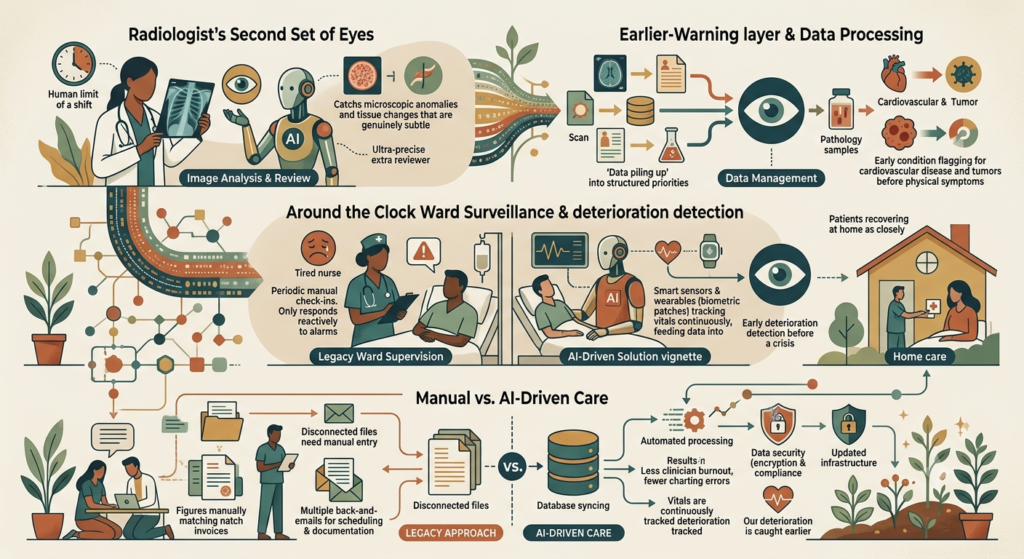
Speed and precision have always been the two things that matter most in medicine. Wait even a few extra days for a diagnosis, and the prognosis can shift dramatically. This is essentially how AI is improving disease diagnosis accuracy acting as an ultra-precise extra reviewer for radiologists, oncologists, and general practitioners who are already stretched thin.
Take imaging, for instance. A human specialist reviewing an X-ray or MRI works off years of training, sure, but also off a finite amount of attention per scan. AI medical diagnosis tools can review thousands of scans in the time it takes a human to finish one, catching the kind of microscopic anomaly that’s easy to miss on a packed schedule.
There’s also an earlier-warning layer to this. By cross-referencing a new patient’s scans against millions of historical records, these systems can flag early signs of conditions like cardiovascular disease or tumors well before symptoms show up physically. And the lab side benefits too pathology samples get automatically sorted and prioritized, so the highest-risk cases land on a physician’s desk first instead of sitting in a queue waiting their turn.
Watching Patients Around the Clock, Not Just Checking In
Nurses can’t physically be in every room at once. That’s just the math of staffing ratios in a busy ward. Traditional bedside monitors mostly worked reactively something drops below a threshold, an alarm goes off, and someone responds. AI patient monitoring systems flip that order around by trying to predict trouble before it actually arrives.
Smart sensors and wearables track a patient’s vitals continuously now, watching everything from heart rate to oxygen levels around the clock, feeding that data into a system that’s always paying attention, not just checking in every few hours. When the data starts trending in a direction associated with, say, respiratory distress, the system can flag it to the nursing station well before things reach crisis point.
This kind of monitoring isn’t confined to hospital walls anymore, either. Patients recovering at home can wear small biometric patches that send data straight back to their care team. That frees up hospital beds for people who actually need to be there physically, while the recovering patient still gets watched closely from a distance.
Old Approach vs. AI-Driven Care
| Clinical Domain | The Legacy Approach | The AI-Driven Solution | Core Benefit |
| Image Analysis & Review | Manual, time-intensive review of complex scans | AI medical diagnosis tools scanning for instant anomalies | Faster diagnostics, fewer missed details |
| Ward Supervision | Periodic manual check-ins on vitals | Continuous tracking via AI patient monitoring systems | Catches deterioration earlier, before a crisis hits |
| Data Management | Disconnected files needing manual entry | Automated processing and database syncing | Less clinician burnout, fewer charting errors |
Notice how almost every row in the old column relies on a human being being physically present at the exact right moment? The AI-driven column mostly removes that dependency, which is really the whole point of automating this kind of work in the first place.
Frequently Asked Questions
Will AI medical diagnosis tools eventually replace human doctors?
Not realistically, no. These tools exist to support a doctor’s judgment, not stand in for it. They’re genuinely good at scanning huge datasets and catching patterns a person might miss, but they don’t carry the intuition or context a doctor brings into an actual treatment decision. A human still reviews the findings and makes the final call.
How exactly is AI improving disease diagnosis accuracy in practice?
The algorithms are trained on enormous datasets millions of verified records, scans, and case histories. When a new patient’s file comes in, the system compares it against that whole repository almost instantly, picking up on tissue or lab variations that would be genuinely hard for a person to spot manually.
How do hospitals use AI for patient monitoring outside the ICU?
Wearable devices like smart bands or chest patches handle this for general ward patients or people recovering at home. They continuously collect baseline data, and the AI backend behind them alerts care teams the moment something starts looking abnormal, even if the patient feels fine in the moment.
Is patient data actually safe with all this monitoring happening constantly?
Security is a major priority for any legitimate healthcare AI platform. They operate under strict compliance frameworks like HIPAA, using encryption and isolated, private cloud systems specifically so sensitive patient data doesn’t end up exposed or improperly shared.
What’s actually slowing down AI adoption in hospitals right now?
Mostly outdated infrastructure. A lot of hospitals are still running on older, fragmented software systems that don’t communicate well with newer AI tools. Fixing that requires real investment in updated infrastructure and shared data standards across departments, which takes time and money most facilities don’t have lying around.
Conclusion
What’s happening with AI in healthcare right now isn’t a small tweak to how hospitals run. Illness gets caught earlier. Patients get watched more consistently than any staffing schedule could realistically manage. And clinicians get their limited time back, free to spend it on decisions that actually need a human mind behind them.
None of this replaces the doctor in the room. It just clears away a lot of the noise that used to slow doctors down, so the parts of medicine that genuinely require human judgment get the attention they deserve.