I asked my phone to set a reminder the other day while juggling grocery bags, half-mumbling the request, and it understood me perfectly. Didn’t think twice about it until later, honestly that’s the whole point of natural language processing working well. You don’t notice it. It just quietly does its job in the background.
That’s kind of wild when you stop and think about it. Just a decade ago, talking to a computer felt clunky, full of “I’m sorry, I didn’t understand that.” Now we type half-sentences into search bars, mumble commands to speakers across the room, and somehow get exactly what we meant. So what changed?
What Natural Language Processing Actually Means
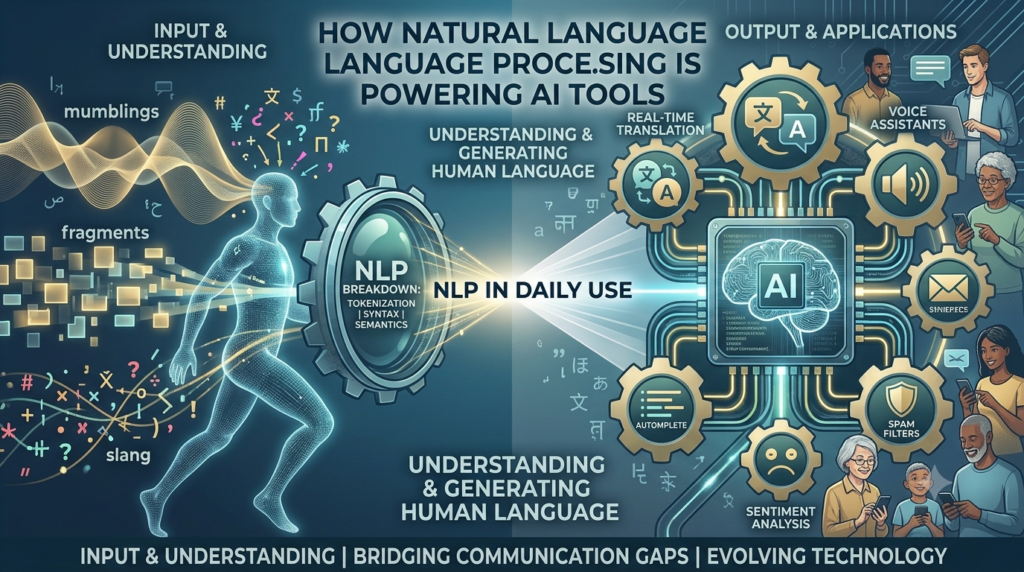
So basically, natural language processing is that part of AI whose whole job is figuring out human language and not the neat, textbook version either. The messy stuff. Slang, half-finished sentences, the way people actually talk and type, not how a grammar book says they should.
Here’s the tricky part. Human language is genuinely a mess. We use sarcasm. We leave out words. We say “that’s sick” and mean two completely opposite things depending on tone. Teaching a machine to navigate that ambiguity isn’t some small technical tweak it’s a massive undertaking.
NLP breaks language into pieces a machine can work with grammar structure, word meaning, context, intent then reassembles an understanding of what’s being communicated. Sounds simple when you say it like that. It really isn’t.
Why NLP Applications Are Suddenly Everywhere
Honestly, NLP applications snuck up on most people. You’re probably using a handful daily without clocking it as “AI” at all.
Spam filters quietly scanning your inbox? NLP. Autocomplete finishing your sentences before you do? NLP. Customer service chatbots that don’t make you want to throw your phone across the room anymore well, most of the time? Also, NLP, and a noticeably better version than what existed five years back.
Search engines lean on it heavily, too. Type in a vague, half-formed question, and results actually grasp what you’re after instead of just matching keywords like it’s 2010. Voice assistants rely on layered NLP models just to figure out what you said before they even attempt to figure out what you meant.
Healthcare has adopted it quietly, too. Doctors’ notes, scribbled or dictated in a hurry, get parsed by NLP systems that pull out relevant medical information for record-keeping. Legal teams use it as well, scanning contracts for clauses that matter, saving what used to be days of manual review.
Real-World Applications of Natural Language Processing You’ve Probably Missed
A few real-world applications of natural language processing fly under most people’s radar entirely.
Social media platforms use NLP to detect harmful content, but also to gauge overall sentiment figuring out whether people are reacting positively or negatively to a brand, a product launch, even a political event, all close to real time. Companies pay close attention because it’s genuinely useful market intelligence.
Resume screening tools increasingly use NLP too, scanning applications for relevant skills before a human recruiter even glances at them. There’s debate about whether that’s entirely fair, and that’s worth asking but it’s happening at scale regardless.
Even predictive text on your keyboard runs on NLP fundamentals, learning your personal writing patterns over time to guess what word you’re reaching for next.
How Language Translation AI Has Quietly Gotten Scary Good
Remember the old translation tools that turned every sentence into something vaguely embarrassing? Type in a normal phrase, get back something that sounded like it had been through a blender. Language translation AI has come a long way from that mess.
Modern systems don’t just swap words one-for-one anymore they’re built to grasp context, idiom, and tone, which is exactly why translations read more naturally now instead of sounding like a dictionary threw up on the page. Feed it “it’s raining cats and dogs,” and it won’t hand back a sentence about actual falling animals.
How AI Improves Real-Time Language Translation
The real-time piece is where things get genuinely impressive, give or take a few hiccups here and there. Apps now translate spoken conversation almost instantly, letting two people who don’t share a language actually hold a back-and-forth conversation without painful pauses for translation.
This works because modern AI improves real-time language translation through massive training on bilingual text and audio data, learning patterns at a scale no human translator could match. The system isn’t translating word by word it’s predicting the most natural-sounding equivalent based on enormous context.
It’s not flawless, to be fair. Idioms still trip things up occasionally, and tone gets lost more often than the marketing demos let on. But compared to where this tech sat even five years ago, the improvement is honestly kind of staggering.
Where NLP Still Struggles
It’s not all smooth sailing, worth saying plainly. Sarcasm remains a genuine weak spot machines still misread it constantly. Context that spans an entire conversation rather than just one sentence trips up plenty of systems too. And bias baked into training data can quietly seep into outputs in ways that are hard to catch until someone notices the pattern.
Conclusion
Honestly, NLP has become such a normal part of daily life that most of us don’t even register it’s there anymore and that’s kind of the whole tell of how far it’s come. From NLP applications quietly sorting your inbox to language translation AI bridging conversations across languages in real time, this stuff has changed how we deal with machines, even if nobody really stopped to clock when it happened. It’s not perfect, and probably won’t be for a while. But it’s already changed more than most of us give it credit for.
FAQs
1. Is natural language processing the same thing as AI? Not quite. NLP is a specific branch within AI, focused entirely on understanding and generating human language, while AI covers a much broader range of capabilities beyond just language.
2. How accurate is language translation AI today? It’s gotten remarkably good for everyday conversation and common phrases, though it can still stumble on idioms, sarcasm, or highly technical or cultural language.
3. Can NLP understand multiple languages at once? Yes, many modern NLP systems are trained across dozens of languages simultaneously, which is actually part of why translation tools have improved so much recently.
4. What’s an everyday example of NLP I’m probably already using? Autocomplete, spam filters, voice assistants, and predictive text on your phone keyboard are all everyday NLP applications most people use without realizing it.
5. Why does NLP sometimes misunderstand what I’m saying? Usually, because human language is inherently ambiguous sarcasm, slang, and context-dependent meaning are still genuinely hard for machines to interpret reliably.