
A store owner I spoke to recently had six different AI tools running on her Shopify store a chatbot, an email tool, a product description generator, and three others she genuinely couldn’t remember signing up for. Sales hadn’t moved much. That’s a pretty common story in ecommerce right now. The category is crowded enough that it’s easy to collect tools without ever fixing the actual thing slowing your store down.
So instead of another giant roundup, let’s break this down by the problem each type of tool actually solves, and how to figure out which one your store needs first.
Start With Your Actual Bottleneck, Not the Tool List
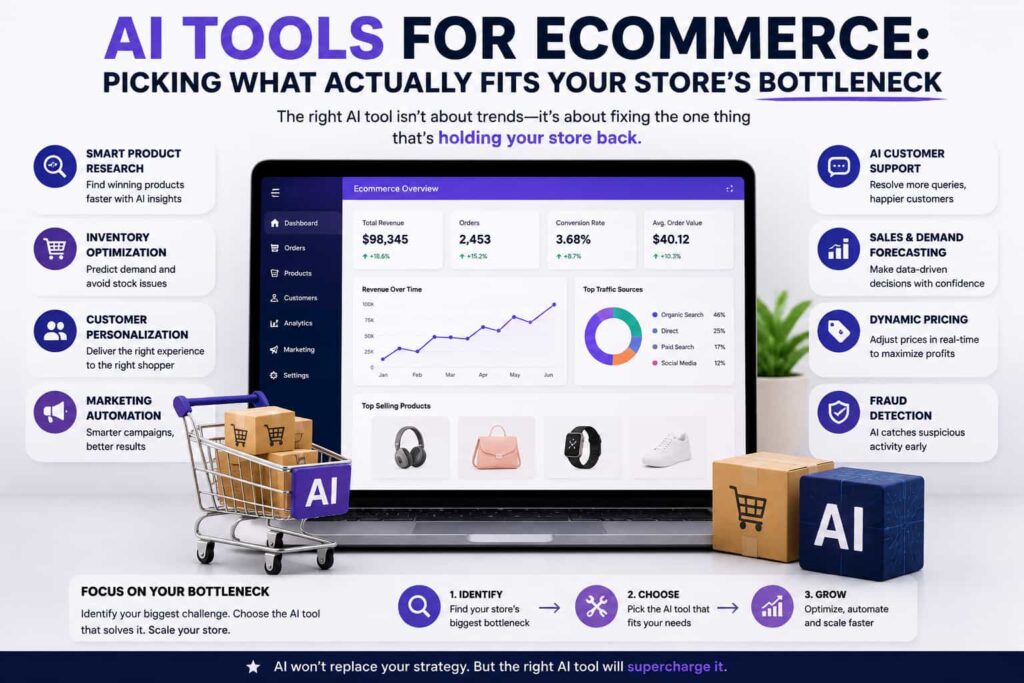
Ecommerce AI tools generally fall into a handful of categories: customer support, product content, email and personalization, product discovery/search, pricing, and analytics. The right starting point depends entirely on where your store is actually losing time or money. If support tickets are piling up, that’s your bottleneck. If your catalog is growing faster than you can write descriptions, that’s a different one. Chasing the tool with the flashiest features instead of the one matching your actual problem is how stores end up with six half-used subscriptions.
Customer Support: Usually the Fastest Win
Support automation tends to deliver the fastest, most measurable return of any category. Modern AI chatbots aren’t the scripted, keyword-matching bots from a few years ago they can read a customer’s actual question, pull real order data, and resolve simple issues directly instead of just deflecting to a help article. For ecommerce specifically, that means handling order tracking, return requests, and shipping questions without a person touching every single ticket.
The metric that actually matters here isn’t how many conversations a bot handles it’s resolution rate and cost per resolution. A tool that “handles” a ticket by giving a vague non-answer isn’t actually saving anyone time.
Product Content: Solving the Catalog Bottleneck
If your store has hundreds or thousands of SKUs, writing unique product descriptions by hand just doesn’t scale. AI content tools generate product copy, ad text, and even structured formatting suited to a specific platform, whether that’s Shopify’s character limits or Amazon’s listing format. The good ones let you upload a brand voice or style guide so output doesn’t sound like a generic template repeated across every product page.
Some tools now extend into product imagery too generating polished visuals or handling repetitive edits across a catalog, which used to require a photographer or designer for every single item.
Email, Personalization, and Marketing
This is where AI tends to show up as the connective tissue of a store rather than a single feature. Tools in this category analyze actual purchase and browsing behavior, then decide who to target, when, and with what message abandoned cart flows, product recommendations inside emails, and audience segments built from a plain-language description instead of manual filtering.
The important detail here is integration. Marketing AI tools that pull from real transaction data make far better decisions than ones working off assumptions or generic industry benchmarks.
Search, Discovery, and Pricing
Shoppers who can’t find what they’re looking for just leave. AI-powered search understands intent rather than requiring an exact product name match, surfacing relevant items even when a search term is vague or slightly off. Pricing tools work on a similar principle tracking competitor pricing and demand signals, then suggesting adjustments instead of a store manually checking competitor pages every week.
Ecommerce AI Tool Categories at a Glance
Category Solves Fastest Impact
Customer support Ticket volume, response time High
Product content Slow catalog growth, weak listings High
Email/personalization Low repeat purchase, generic marketing Medium
Search/discovery Shoppers not finding products Medium
Pricing Manual competitor tracking Medium
Analytics Unclear performance across channels Lower, but compounding
Old Manual Workflow vs. AI-Assisted Workflow
Manual Process AI-Assisted Process
Writing product descriptions Hours per batch of SKUs Minutes, with brand voice applied
Answering support tickets One at a time, by a human Instant for routine questions
Building email segments Manual filtering by hand Built from a plain-language description
Tracking competitor pricing Manual checks Continuous, automatic monitoring
How to Actually Choose Without Overbuying
Start with the bottleneck that’s costing you the most time or money right now, not the category with the most buzz. If tickets are piling up, start with support automation before touching anything else. If your catalog is the problem, a content tool solves that specific pain without needing a full marketing stack overhaul.
It’s also worth checking how deeply a tool integrates with your actual platform Shopify, WooCommerce, whatever you’re running since a tool that requires a complex custom build to connect properly often isn’t worth the setup cost for a smaller store. And be skeptical of tools promising instant transformation; the ones that actually work tend to show measurable impact within weeks, not months, because they’re solving one specific problem well rather than promising to fix everything at once.
If your bottleneck turns out to be broader than any single ecommerce tool spanning support, admin, and internal coordination it’s worth stepping back and looking at how to automate your business with AI more holistically, rather than stacking ecommerce-specific tools on top of each other.
The Bottom Line
AI tools for ecommerce aren’t a single purchase decision they’re a set of specific solutions to specific bottlenecks: support volume, catalog scale, generic marketing, poor search, manual pricing checks. The stores that actually see results pick the one or two categories causing the most pain, get those working well, and expand from there, instead of collecting tools and hoping something sticks.
FAQs
Which AI tool should an ecommerce store start with? It depends on your biggest bottleneck. Customer support automation and product content tools tend to deliver the fastest, most measurable returns for most stores.
Do AI ecommerce tools work with Shopify and WooCommerce? Most modern AI ecommerce tools integrate directly with major platforms like Shopify and WooCommerce through apps or plugins, pulling in product, order, and customer data automatically.
Are AI chatbots actually good enough to replace human support for ecommerce? They’re strong for routine, repetitive questions like order tracking or return requests, but complex or emotionally sensitive situations still generally need a human agent.
Is AI-generated product content good enough to use as-is? Quality varies by tool, but the better ones let you upload a brand voice or style guide, producing content that usually needs light editing rather than a full rewrite.
How many AI tools does an ecommerce store actually need? Most ecommerce teams run somewhere between five and eight AI tools across categories like support, marketing, content, and analytics, though smaller stores can often start with just one or two.
Further reading:
Fin AI – 15 Best AI Tools for Ecommerce in 2026
Cybernews – Best AI Tools for eCommerce 2026
Yotpo – 7 Best AI Tools For Ecommerce In 2026