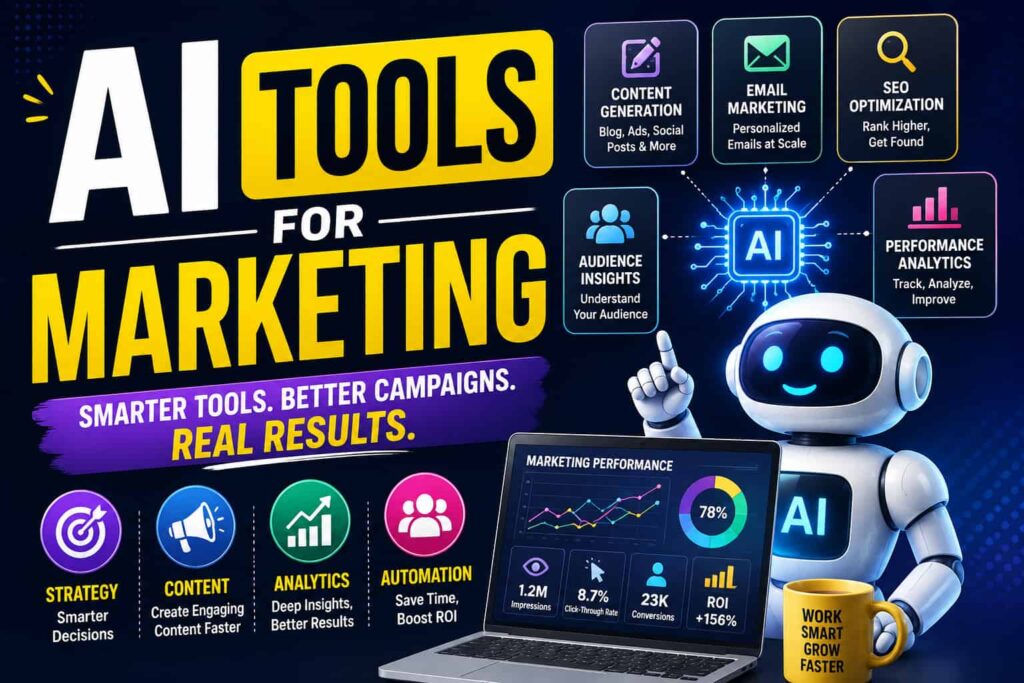
A few years ago, “AI marketing tool” mostly meant a chatbot that could write a slightly awkward blog intro. That’s changed fast. Marketing teams today are using AI for everything from predicting which campaign will actually convert to auto-building entire email sequences from a single prompt and according to a recent Salesforce State of Marketing report, the vast majority of marketers are already using AI tools in some form.
The catch is that “AI marketing tool” now covers so much ground that picking the right one isn’t obvious anymore. Content generation, SEO, analytics, social scheduling, workflow automation they all fall under the same umbrella, but they solve completely different problems. The point of this guide is to break that down by what each type of tool is actually good for, not just list names.
Content Creation and Copywriting
This is still the most common entry point for marketers experimenting with AI, and for good reason writing at scale is genuinely time-consuming.
- Jasper built for producing long-form content at scale, useful for teams that need consistent blog and campaign output without starting from a blank page every time
- Copy.ai leans more toward short-form copy: ad text, product descriptions, email lines
- ChatGPT still widely used as a general-purpose assistant for drafting, brainstorming, and summarizing, even if it’s not built specifically for marketing workflows
The honest tradeoff here is that AI-generated drafts almost always need a human editing pass for tone, accuracy, and making sure the content doesn’t sound like every other AI-written post out there.
SEO and Content Optimization
AI has changed SEO work more than almost any other marketing function, mostly by automating the research grunt work that used to eat hours.
- Semrush combines SEO research with AI-assisted content strategy, useful for keyword planning and competitive analysis in one place
- Surfer SEO focused specifically on optimizing individual pieces of content against what’s already ranking
These tools are less about writing content and more about making sure the content you’ve already written has a real shot at ranking.

Analytics and Predictive Insights
This is where AI arguably delivers the most measurable value, since it’s working with data marketers already have rather than generating something new.
- Improvado pulls together marketing data across platforms into one place, with AI layered on top for forecasting and pattern detection
- HubSpot AI / Salesforce Einstein embedded AI inside CRM platforms, useful for pipeline forecasting and lead scoring without needing a separate analytics tool
Predictive analytics tends to be the AI use case marketing teams adopt earliest, mainly because it plugs into workflows and data they’re already using.
Social Media and Campaign Management
- Sprout Social AI-assisted scheduling, listening, and reporting for teams managing multiple social channels
- Planable built around content collaboration and approvals, useful for teams where a lot of people need to sign off before something goes live
Email and Workflow Automation
- Klaviyo AI-driven segmentation and send-time optimization for email marketing, particularly popular with ecommerce brands
- Gumloop connects AI models to existing internal tools and workflows without requiring code, similar in spirit to Zapier but with an AI layer built in
Workflow automation tools like this tend to save the most time not because they’re flashy, but because they quietly remove repetitive manual steps from campaigns that used to require constant babysitting.
How to Actually Choose Between Them
With this many categories, the temptation is to try everything at once. That usually backfires. A more practical approach:
- Start with your biggest time sink, not the newest tool on the market
- Pick one tool per problem, rather than stacking three overlapping ones
- Check data handling policies before connecting a tool to customer or campaign data, especially for anything enterprise-facing
- Give a tool real time before switching a lot of AI tools improve significantly once they’ve learned your brand voice or campaign patterns
Quick Reference: AI Marketing Tools by Category
| Category | Tools | Best For |
|---|---|---|
| Content creation | Jasper, Copy.ai, ChatGPT | Drafting blogs, ad copy, email content at scale |
| SEO & optimization | Semrush, Surfer SEO | Keyword research, content ranking improvements |
| Analytics & prediction | Improvado, HubSpot AI, Salesforce Einstein | Forecasting, pipeline insights, pattern detection |
| Social media | Sprout Social, Planable | Scheduling, listening, team approvals |
| Email & automation | Klaviyo, Gumloop | Segmentation, send-time optimization, workflow automation |
Common Mistakes Teams Make With AI Marketing Tools
- Treating AI output as final, rather than a first draft that still needs a human editing pass
- Buying tools before mapping the actual bottleneck they’re supposed to fix
- Ignoring integration with existing platforms, which often causes more manual work, not less
- Skipping a real evaluation period, then judging a tool on week one performance
If content production specifically is your bottleneck, it’s worth pairing an AI writing tool with a clear content workflow our guide on building an efficient content marketing workflow covers that in more detail.
The Bottom Line
There isn’t one “best” AI marketing tool there’s a best combination for your specific bottleneck. Content teams get the most from tools like Jasper or Semrush, data-heavy teams benefit more from Improvado or embedded CRM AI, and teams drowning in repetitive tasks tend to see the biggest win from workflow automation like Gumloop. The smartest move is usually to fix your biggest time sink first, get comfortable with one tool, and expand from there rather than adopting everything at once.
For a broader, regularly updated breakdown of AI tools across every marketing function, Zapier’s guide is a solid resource to bookmark: The Best AI Marketing Tools in 2026.
Frequently Asked Questions
1. What are the best AI tools for marketing in 2026? It depends on the use case Jasper and Copy.ai lead in content generation, Semrush and Surfer SEO in optimization, and Improvado or HubSpot AI in analytics and forecasting.
2. Can AI tools completely replace a marketing team? No. AI tools speed up repetitive tasks like drafting, scheduling, and data analysis, but strategy, brand voice, and final review still need human judgment.
3. Are AI marketing tools expensive? Pricing varies widely many tools offer free or low-cost starter tiers, while enterprise-grade platforms with deeper integrations can cost significantly more per month.
4. What’s the easiest AI marketing tool to start with? General-purpose tools like ChatGPT are often the easiest entry point, since they require no setup and can help with drafting, brainstorming, and quick research.
5. How do I know which AI marketing tool is right for my team? Identify your biggest time-consuming task first content, data analysis, or campaign management then choose a tool built specifically for that function rather than a generalist platform.