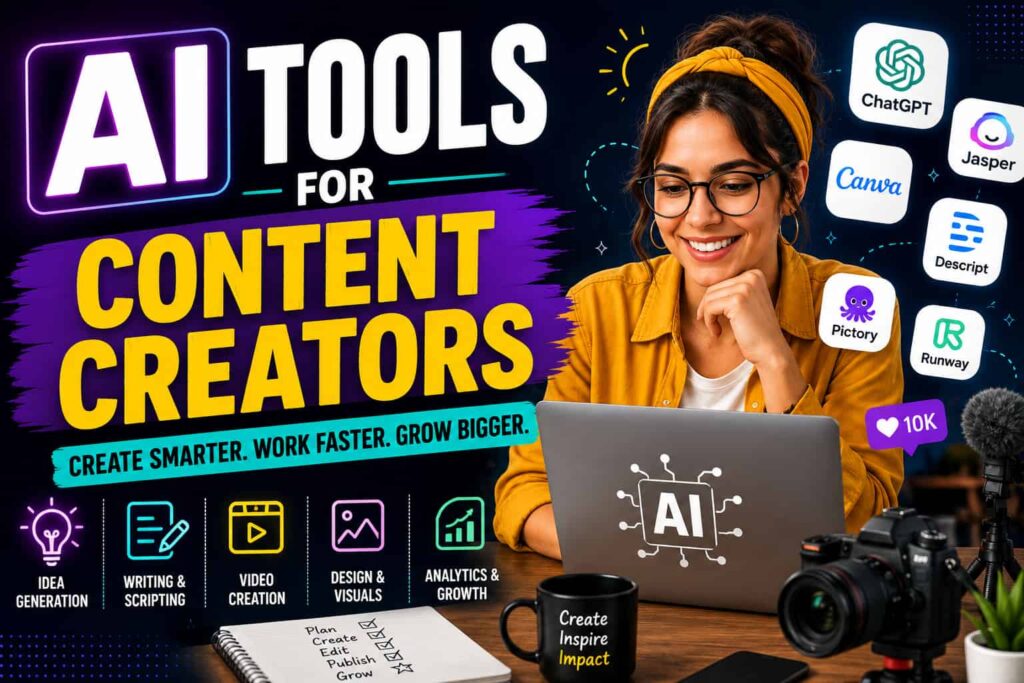
If you create content for a living or even just as a serious side hustle you’ve probably noticed there’s a new “must-have AI tool” being pushed every single week. Most of them promise to 10x your output overnight. Realistically, a handful of AI tools for content creators genuinely save time and improve quality, and the rest are mostly noise dressed up as innovation.
Here’s a grounded look at what’s actually useful, broken down by what creators actually spend their time doing.
Tools for Writing and Scripting
AI writing assistants Useful for drafting outlines, brainstorming angles on a topic, or getting past a blank page. Most creators find them best as a starting point rather than a finished product the editing and personal voice still need a human touch.
Script and caption generators For short-form video, generating a rough script or a handful of caption variations quickly can shave off a good chunk of prep time, especially when you’re publishing daily or near-daily.
Grammar and tone checkers Beyond catching typos, these flag tone inconsistencies, which matters a lot if you’re writing across multiple platforms with different voices (professional on LinkedIn, casual on Instagram, for example).
Tools for Design and Visuals
AI image generators Handy for thumbnails, blog headers, or quick visual concepts when you don’t have a designer on call. Worth noting: results vary a lot by platform, and some work better for realistic images while others shine at illustration-style work.
Background removal and photo editing tools What used to take real Photoshop skill can now be done in seconds, which is a genuine time-saver for creators handling their own visuals.
AI video editing assistants Tools that auto-cut silences, generate captions, or suggest highlight clips from longer footage cut editing time down noticeably, especially for creators without a dedicated editor.

Tools for Research and Planning
Trend and topic research tools AI tools that scan what’s currently performing well in a niche can help with content planning, though they work best as one input among several, not the whole strategy.
SEO and keyword tools For blog or long-form content specifically, AI-assisted keyword research speeds up a process that used to involve a lot of manual digging through search data.
Content repurposing tools Turning one long-form piece (a podcast, video, or article) into multiple smaller pieces for different platforms is one of the more genuinely time-saving uses of AI right now.
Comparison: Where Each Tool Type Actually Helps
| Tool Type | Best Used For | Watch Out For |
|---|---|---|
| Writing assistants | Outlines, first drafts, brainstorming | Losing your personal voice if overused |
| Script/caption generators | Fast short-form content prep | Sounding generic without editing |
| Grammar/tone checkers | Consistency across platforms | Over-correcting natural phrasing |
| Image generators | Thumbnails, quick visual concepts | Inconsistent quality across styles |
| Photo/video editing tools | Cutting production time | Losing hands-on editing control |
| Trend/topic tools | Content planning input | Chasing trends with no personal angle |
| SEO/keyword tools | Faster research | Over-optimizing at the cost of readability |
| Repurposing tools | Multi-platform content from one piece | Content feeling recycled if untouched |
Using AI Without Losing What Makes Your Content Yours
The creators who get the most out of AI tools tend to treat them as a first draft or a research shortcut, not a finished product. A few habits that keep content from feeling generic:
- Always run AI-generated drafts through your own editing pass voice and personality rarely survive untouched AI output.
- Use AI for the repetitive, time-consuming parts (formatting, captions, first drafts) and keep the creative direction yours.
- Be transparent with your audience if AI played a significant role in visuals or writing, especially as platforms start rolling out disclosure expectations.
- Don’t let AI-suggested trends replace your own read on what your specific audience actually wants.
Why Audiences Can Tell the Difference
There’s a growing fatigue among audiences toward content that feels obviously AI-generated overly polished, generic phrasing, stock-sounding advice. The creators who stand out are usually the ones using AI to handle the boring parts faster, while keeping their actual perspective, humor, and voice front and center. That balance is really the whole game.
If you’re building out a broader content workflow, our guide on building a content calendar that actually works pairs well with a lot of these tools. And if you’re specifically focused on written content, our AI tools for students piece covers overlapping writing and research tools from a different angle.
For broader, non-promotional perspectives on AI in creative work, Adobe’s guide to AI in creative workflows and the Content Marketing Institute both offer grounded takes on where these tools genuinely add value.
Bottom Line
AI tools for content creators are most useful when they take over the repetitive, time-eating parts of the job drafting, formatting, basic edits so you can spend more time on the parts that actually require a human perspective. Used that way, they’re a real advantage. Used to replace your voice entirely, they tend to blend into the flood of content that already looks and sounds the same.
FAQs
Do AI tools for content creators actually save time, or just shift the work? They genuinely save time on repetitive tasks like drafting and formatting, but the editing and personalization step still takes real effort it shifts where your time goes rather than eliminating it entirely.
Will using AI tools make my content sound generic? It can, if you publish AI output without editing it. Running everything through your own voice and perspective is what keeps it from sounding like everyone else’s AI content.
Are AI image generators good enough to replace a designer? For quick thumbnails or concepts, often yes. For polished brand visuals or complex custom work, a human designer still tends to produce more consistent, on-brand results.
Should I disclose when I’ve used AI tools in my content? It’s increasingly expected, especially for AI-generated visuals or heavily AI-assisted writing. Checking your platform’s specific policy is a good habit either way.
What’s the single most useful AI tool for a content creator just starting out? A solid writing assistant paired with a repurposing tool tends to give the most immediate time savings for creators managing multiple platforms alone.