Every other week there’s a new AI app claiming it’ll fix your grades, write your essays, or turn you into a straight-A student overnight. Most of that is marketing noise. But underneath the hype, there genuinely are AI tools for students that save real time and make studying less painful the trick is knowing which ones are actually worth your attention.
Here’s an honest rundown, without the exaggerated promises.
Tools for Studying and Understanding Material
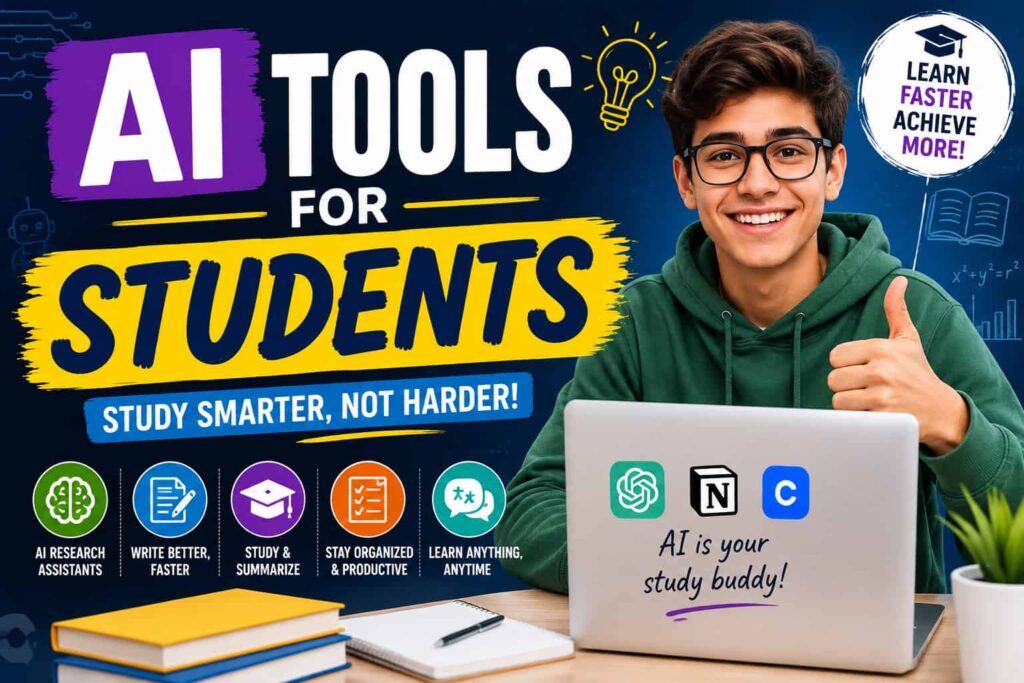
AI-powered flashcard and quiz generators Tools that turn your notes or textbook chapters into flashcards or quizzes automatically save a huge amount of manual prep time. Instead of spending an hour making study cards, you can spend that hour actually reviewing them.
Chatbots for explaining concepts Asking an AI chatbot to explain a confusing topic in simpler terms, or with a different example, can genuinely help when a textbook explanation just isn’t clicking. It’s not a replacement for a teacher, but it’s a decent second opinion at 11 PM before an exam.
Summarization tools For long readings or dense research papers, AI summarizers can pull out the main points quickly, which is useful for deciding what’s actually worth reading in full versus skimming.
Tools for Writing and Research
Grammar and writing assistants Beyond just catching typos, modern AI writing tools flag awkward phrasing, tone issues, and structural problems, which is genuinely useful for essays and reports.
Citation and reference generators These save an enormous amount of tedious formatting time, especially for longer research papers with a lot of sources.
Research assistants Some AI tools can help narrow down a broad topic into a workable research question, or point toward relevant sources faster than manually digging through search results.
A word of caution here: using AI to edit or organize your own writing is very different from using it to write the whole thing for you. Most schools have clear rules against the second one, and it also means you’re not actually learning the material which tends to catch up with you eventually.

Tools for Staying Organized
AI scheduling assistants These can look at deadlines, class times, and study goals, then suggest a realistic study schedule instead of you guessing how to fit everything in.
Note-organization tools AI-powered note apps that automatically tag, summarize, or link related notes together make reviewing before exams noticeably faster.
Comparison: What Each Type of Tool Is Actually Good For
| Tool Type | Best Used For | Watch Out For |
|---|---|---|
| Flashcard/quiz generators | Active recall studying | Relying on it instead of understanding material |
| Chatbot explainers | Clarifying confusing topics | Blindly trusting answers without double-checking |
| Summarizers | Deciding what to read in full | Missing nuance in complex texts |
| Writing assistants | Polishing grammar and tone | Letting it rewrite your actual arguments |
| Citation generators | Saving formatting time | Not verifying citation accuracy |
| Scheduling tools | Realistic study planning | Over-relying on rigid auto-schedules |
| Note organizers | Fast exam review | Skipping the act of writing notes yourself |
Using AI Tools Without Getting in Trouble
Most universities now have specific policies on AI use, and they vary a lot some allow AI for brainstorming or editing but not drafting, others are stricter across the board. A few practical habits keep things safe:
- Always check your school’s or professor’s specific AI policy before using any tool for graded work.
- Use AI for understanding and organizing, not for producing final work you submit as entirely your own.
- Fact-check anything an AI chatbot tells you they’re confident even when wrong, and that’s a real risk for factual coursework.
- Keep a record of how you used the tool if your school requires disclosure, since expectations here are still evolving.
Why “Using AI” Isn’t the Same as “Using It Well”
The students who genuinely benefit from AI tools tend to use them as a supplement clarifying a concept, saving time on formatting, or organizing a messy set of notes rather than as a shortcut around actually learning. The ones who lean on it to skip the work entirely usually end up struggling later, especially in classes that build on earlier material.
If you’re also trying to sharpen general study habits alongside these tools, our guide on effective study techniques for students covers methods that pair well with AI-assisted review. And if academic integrity policies are a concern, our understanding AI use in academic work piece breaks down common school policies in more depth.
For broader, research-informed perspectives on AI in education, UNESCO’s guidance on AI and education and Harvard’s Teaching and Learning Lab both offer thoughtful, non-hype takes on where these tools genuinely help and where they don’t.
Bottom Line
AI tools for students aren’t magic, and they’re not cheating by default either it really depends on how they’re used. The ones worth keeping around are the ones that save time on the tedious parts of studying (formatting, organizing, quizzing yourself) so you can spend more energy on the parts that actually build understanding. Used that way, they’re a genuine advantage. Used as a shortcut, they tend to catch up with you eventually.
FAQs
Are AI tools for students considered cheating? It depends entirely on how they’re used and your school’s specific policy. Using AI to edit or organize your own work is generally fine; using it to generate work you submit as your own usually isn’t.
What’s the most useful type of AI tool for exam prep? Flashcard and quiz generators tend to be the most directly useful, since they turn passive notes into active recall practice quickly.
Can AI chatbots be trusted for factual information? Not entirely they can sound confident while being wrong, so it’s worth double-checking anything factual before relying on it for coursework.
Do AI writing tools weaken actual writing skills over time? They can, if used to replace the writing process entirely rather than to polish and refine your own drafts. Balance matters here.
Should I tell my professor if I used an AI tool for an assignment? If your school has a disclosure policy, yes and even without one, it’s generally safer to check beforehand than to assume it’s fine.