My smart camera used to take two seconds to flag a package on the porch, long enough that whoever grabbed it was gone. Then an update moved the detection model onto the camera itself, and now it catches motion before the person reaches the steps. That shift, from sending data to a distant server toward running the model right where it shows up, is the story behind edge computing and AI. This piece covers how edge AI devices process data instantly and where real-time AI processing is already changing industries.
What Is Edge Computing and AI
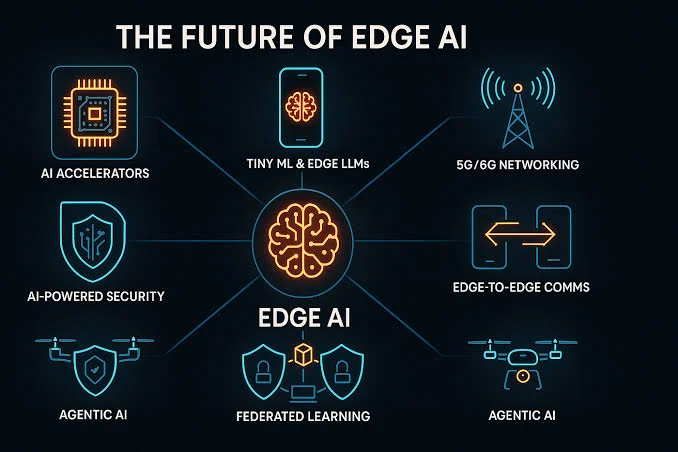
Edge computing and AI are the pairing of two ideas. Edge computing moves data processing closer to where it is generated, on a device or a local gateway, instead of a faraway cloud data center. AI adds the intelligence layer, so processing becomes actual analysis and decision-making.
NIST describes edge computing as the network layer that includes end devices, providing local computing capability on a sensor or other network device. Once AI runs inside that layer, a camera or sensor can make a judgment call on its own instead of waiting on a round trip to the cloud.
How Edge AI Devices Process Data Instantly
Most edge AI devices carry a compact version of a trained model, shrunk through quantization so it fits on limited hardware. The model runs directly on the chip, so data never has to leave the building to get an answer.
A widely cited review on edge AI notes that fusing edge computing with AI cuts latency while improving energy efficiency. That is why a factory sensor catches a vibration anomaly in milliseconds, and why a self-driving car cannot wait on a cloud server for a decision.

Key Features of Modern Edge AI Systems
Edge AI setups share a handful of core traits. On-device inference lets a chip run a trained model without internet. Data filtering sends only a trimmed summary to the cloud. Low-power design lets a battery-powered sensor run AI tasks for months. Local decision-making means the device triggers an action, like shutting off a machine, without waiting on a remote system. These traits let real-time AI processing happen at the edge.
Pros and Cons of Edge Computing and AI
Latency is the headline benefit. Cutting the round trip to a distant server means decisions that took a second now happen in milliseconds. Privacy improves too, since sensitive information, like a face on a security camera, stays local.
The tradeoffs are real. Edge hardware has less compute power than a cloud server, so models must be smaller. Managing updates across thousands of scattered devices is harder than updating one central server. Physical devices can also be lost, stolen, or tampered with in ways a locked data center never faces.
Pricing for Edge AI Devices and Platforms
Pricing depends on scale and hardware. Basic edge AI boards start around fifty to two hundred dollars for small pilots. Industrial edge gateways with AI acceleration usually run several hundred to a few thousand dollars per unit. Full platform subscriptions are custom quoted based on device count.
Best Use Cases for Real-Time AI Processing
Manufacturing plants use edge AI for predictive maintenance, catching failures before they cause downtime. Retail stores run computer vision at the edge for inventory checks and checkout automation. Healthcare wearables use local processing to flag an irregular heartbeat the moment it happens, exactly why real-time AI processing matters for IoT. Smart cities lean on edge sensors for traffic signal timing.
Comparison Table, Edge AI Deployment Options
| Deployment Type | Best For | Free Plan | Typical Rating |
| Edge AI Dev Boards | Hobbyist projects and pilots | Often open-source firmware | 4.3 out of 5 |
| Industrial Edge Gateways | Factories and logistics hubs | Rare, mostly paid | 4.4 out of 5 |
| Smart Camera Systems | Retail and security | Limited free tier | 4.2 out of 5 |
| Fleet Management Platforms | Managing many edge devices | Trial periods only | 4.5 out of 5 |
Alternatives Worth Exploring
Not every workload needs full edge deployment. Cloud-based AI inference works well for tasks that are not time-sensitive.
See our guide on the best AI tools for creators for AI options that run entirely in the cloud.
Hybrid setups, where light filtering happens at the edge and heavier analysis runs in the cloud, balance cost against speed. Businesses newer to AI infrastructure may also check our piece on machine learning basics, and our breakdown of AI content creation tools for creators covers a different corner of the toolkit.
[INSERT IMAGE HERE: edge-ai-comparison-table.webp]
Verdict: Is Edge Computing and AI Worth Adopting
Edge computing and AI are not a niche fix for one industry, it is becoming standard wherever a delay of a second causes a real problem. Teams that need instant response, tight bandwidth, or strong privacy get the most value from moving processing to the edge.
Starting with one well-defined use case beats trying to convert an entire operation at once. Our roundup of AI in gaming industry trends shows a similar pattern of AI adoption moving from hype into daily practice.
FAQs
What is the difference between edge computing and cloud computing? Edge computing processes data close to where it is created, while cloud computing sends data to a distant center first. Edge cuts latency; cloud offers more raw power.
How do edge AI devices process data instantly? They run a compact, optimized model directly on the device’s chip, so no network round trip is needed before a decision gets made.
Why does real-time AI processing matter for IoT? Because many IoT use cases cannot afford even a one-second delay. Local processing keeps the response immediate even if the network drops.
Is edge AI more expensive than cloud AI? Not always. Hardware costs more upfront, but ongoing cloud transfer fees add up fast at scale, so edge often pays off over time.
Conclusion
Edge computing and AI together solve a problem cloud-only systems cannot: some decisions cannot wait for a round trip across the internet. Businesses getting the most value start small and expand from there. Testing one edge AI device this year is a low-risk way to see the difference.