A few years ago, finding out about a shipping delay meant a phone call and a lot of guessing. Now that delay gets flagged before the truck even leaves the dock. AI in supply chain has moved off the conference stage and into the daily grind of warehouses and procurement teams. Nobody is debating whether to adopt it anymore; the real question is how fast a company can scale it.
What Is AI in Supply Chain
AI in supply chain refers to machine learning models and automation tools that plan, predict, and execute logistics decisions with little manual input, covering demand forecasting, inventory management, route planning, and supplier risk.
Supply chains generate huge amounts of data every day, from purchase orders to shipping manifests to weather reports. Traditional software could store that mess but never really understood it. Models now sift through thousands of variables at once and notice things a human planner would miss. Feed a model years of sales history, and it starts catching demand spikes weeks before they hit a warehouse floor, which is why supply chain automation has climbed to the top of board agendas.
How It Works
These systems pull data from ERP platforms, IoT sensors, supplier feeds, and historical sales records, feeding models built to spot patterns and turn them into forecasts or recommendations. In a lot of setups, that is where the AI stops, handing a planner a suggestion to approve or reject. Newer, agentic versions go further and act on their own within set limits, rerouting a shipment or triggering a reorder without waiting for approval.
Even so, most companies still lean on a hybrid setup where the AI recommends, and a person makes the final call. Trust in fully autonomous systems tends to build slowly in industries where one wrong decision can shut down a production line, so this in between approach is likely to stick around for a while.
Key Features
Most platforms bundle several capabilities together. Demand forecasting AI is usually the anchor feature, pulling in historical and external data to predict what customers will want and when. Inventory optimization works out ideal stock levels for every location, cutting both overstock and empty shelves. Route and fleet software finds the fastest, cheapest paths for trucks and ships, adjusting when weather or traffic gets in the way. Supplier risk monitoring scans news, financial filings, and shipping data to flag a problem before it reaches production.
Predictive maintenance rounds out the list, a bigger deal in manufacturing and shipping than most people expect. Sensors on equipment can now catch a failing part before it breaks down. Maritime operators have leaned hard into this, and maintenance AI has reportedly cut vessel downtime by more than a third, according to Maersk’s sustainability research.

Pros
Once a company gets past the pilot stage, the upside shows up fast. Forecasting accuracy is usually the first thing to improve, with enterprises using AI for demand forecasting reporting accuracy gains north of 35 percent, according to IBM’s Global AI Adoption Index. Mature AI supply chain operations also show measurable profitability gains over peers. Fuel costs and delivery times both come down once route optimization kicks in, and risk tools catch supplier trouble early.
Cons
None of this comes free of friction. Implementation costs can climb fast, and integrating AI with a legacy ERP system is usually the messiest part of the rollout. Data quality is another constant headache, since a model is only as good as what feeds it. Returns also take longer than expected, with most organizations waiting two to four years before results feel satisfying. There is also a real trust gap, with planners hesitant to hand critical decisions to a system they do not fully understand.
Pricing
Pricing swings a lot by scale and vendor. A small or mid sized business can usually start with cloud based tools priced per user or per warehouse, often around a few hundred dollars a month. Enterprise platforms from SAP, Oracle, and Microsoft typically come with custom quotes tied to data volume, and contracts can run into six or seven figures a year. Most vendors offer tiered pricing so a smaller operation can start basic and add agentic automation later.
Best Use Cases
A handful of industries see the fastest payoff. Retail and e commerce companies lean on demand forecasting ahead of seasonal spikes. Manufacturers get the most out of predictive maintenance, since one avoided stoppage can cover the tool’s cost for months. Logistics providers chase fuel savings through route optimization across large fleets. Pharmaceutical and food companies increasingly use digital twins to cut spoilage and manage shelf life.
Comparison Table
| Capability | Primary Goal | Typical Users | Human Involvement |
| Demand Forecasting AI | Predict future demand | Retail, e commerce | Low to medium |
| Inventory Optimization | Balance stock levels | Manufacturing, retail | Medium |
| Route Optimization | Cut delivery cost and time | Logistics | Low |
| Supplier Risk Monitoring | Flag issues early | Procurement teams | Medium to high |
| Predictive Maintenance | Prevent equipment failure | Manufacturing, shipping | Medium |
Alternatives
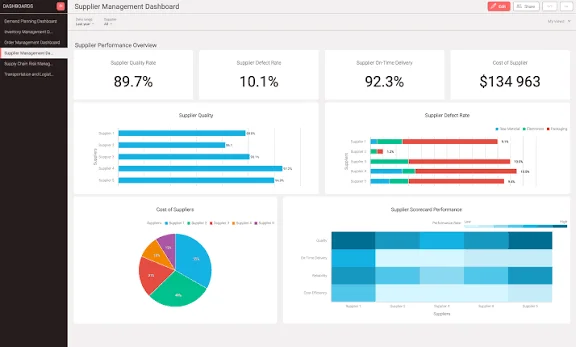
Not every company is ready to jump into a full AI platform. Traditional statistical forecasting, spreadsheet based planning, and rules based automation still get the job done for simpler operations. Some businesses keep human planners firmly in charge while using AI only for data visualization and alerts. A standalone route optimizer is another low risk starting point.
FAQs
Is AI in the supply chain only for large enterprises? Not anymore. Cloud based tools have brought forecasting and inventory AI within reach for small and mid sized businesses too.
How long does it take to see results? Most organizations report meaningful returns within two to four years, while smaller pilot projects can show early wins in a matter of months.
Does AI replace supply chain planners? Rarely. The technology mostly supports human decisions rather than taking them over entirely.
What is the biggest barrier to adoption? Poor data quality and fragmented legacy systems, more than cost or lack of interest.
Verdict
This category of tools has stopped being an experiment. It is quickly turning into standard infrastructure for any company that wants to stay competitive. The technology shines brightest in demand forecasting, route optimization, and predictive maintenance, spots where the data is rich, and the payoff is easy to measure. It is not a plug and play fix, though, since data quality and integration headaches take patience to work through. Companies willing to push past that early friction tend to see efficiency gains that are well documented. Start small with one high impact use case, prove it works, then build out from there.