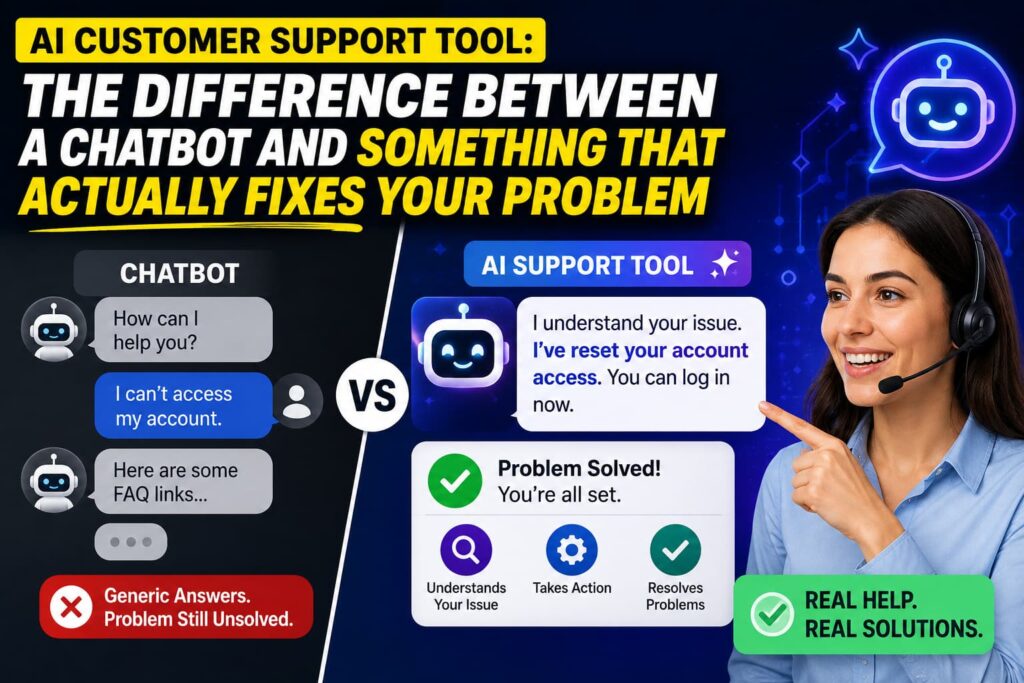
I think most of us have had that one bad chatbot experience typing “I need a refund” and getting looped back to “Have you tried restarting the app?” three times in a row before finally begging for a human. That memory is exactly why a lot of people are skeptical the moment they hear “AI customer support.” Fair reaction, honestly. But the tools running behind the scenes in 2026 aren’t really the same thing anymore, even if they still show up as a chat box on a website.
Let’s actually get into what an AI customer support tool does now, how it works, and where it genuinely helps versus where a human still has to step in.
What an AI Customer Support Tool Actually Is
At its simplest, it’s software that uses AI to read, understand, and respond to customer questions through chat, email, or other channels without a human writing every single reply. That much hasn’t changed since the early chatbot days. What has changed is depth. Older bots followed rigid scripts: if the message contains “refund,” show the refund FAQ. Modern tools actually read the situation tone, order history, how urgent the issue sounds and respond accordingly, instead of matching keywords to a pre-written answer.
The better tools don’t just answer questions either. They can pull up an actual order, check a shipping status, process a return, and confirm it’s done, all inside the same conversation.
How It Actually Works
It starts with understanding the message itself. Using natural language processing, the tool figures out what the customer actually wants, not just which words they used. A frustrated customer typing “this is the third time I’ve had to email about my broken order” gets read differently than someone casually asking about delivery times.
From there, it checks context. This is the part that actually makes modern tools useful pulling in order history, account details, or past support tickets so the response isn’t generic. Instead of “please check your order status page,” it can say exactly when your package left the warehouse, because it actually looked.
Then comes the response itself, or the action. Simple, common questions get resolved on the spot. More complex situations get routed to a human agent, but with full context already attached, so the customer doesn’t have to explain the whole problem again. Some tools go further and act directly issuing a refund, updating a shipping address, canceling a subscription instead of just explaining how to do it.
Behind the scenes, there’s also a tagging and routing layer constantly working, classifying every incoming ticket, setting priority based on urgency and sentiment, and sending it to the right team without someone manually sorting through a queue.
What’s Actually Running Under the Hood
Part What it’s doing
Natural language understanding Reads intent, tone, and urgency from the message
Context lookup Pulls order history, account data, or past tickets
Response generation Answers routine questions in natural, specific language
Action execution Processes refunds, cancellations, or updates directly
Ticket routing Tags, prioritizes, and assigns tickets automatically
Escalation Hands off complex cases to a human with full context attached
Chatbot Era vs. Where Things Actually Are Now
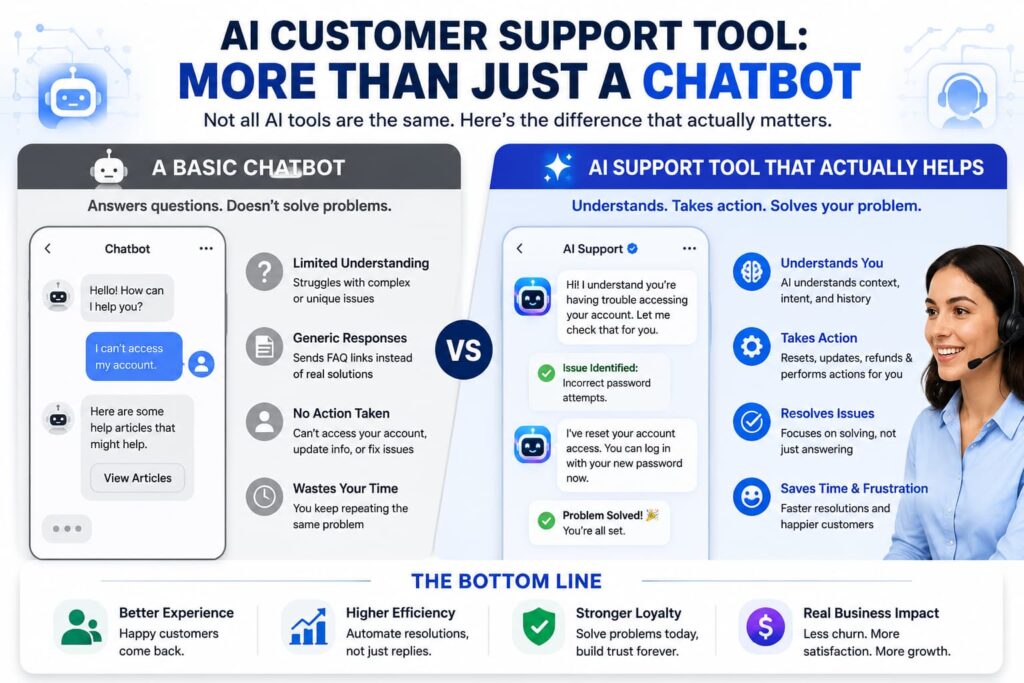
Old-Style Chatbot Modern AI Support Tool
Understands intent Barely, keyword-based Yes, reads context and tone
Pulls real account data No Yes
Can take action, not just explain No Often, yes
Escalates with context No, starts over with human Yes, hands off full history
Improves over time Rarely Yes, learns from resolved tickets
Where This Genuinely Helps
The obvious win is speed. A customer emailing at midnight doesn’t have to wait until morning for someone to open the ticket the AI reads it immediately and either solves it or gets it moving, changing first-response times from hours to minutes.
The less obvious win is what it frees humans up to do. When routine questions where’s my order, how do I reset my password get handled automatically, agents spend their time on situations that actually need judgment: an angry customer, an unusual edge case. That’s a better use of a person’s time than typing the same shipping update for the fortieth time.
Where a Human Still Needs to Be in the Loop
This isn’t a “replace your support team” situation, and it’s worth being upfront about that. Emotional, high-stakes, or unusual cases still need a person AI is good at volume, not at reading between the lines of a genuinely upset customer who needs to feel heard. The realistic model most teams land on is AI handling the routine stuff at scale, while humans focus on exceptions and moments that need empathy.
It’s also worth knowing that production-grade tools need to be grounded in your actual approved knowledge and policies, not a general-purpose AI improvising an answer. A tool that sounds confident but wrong about your return policy is worse than no automation.
If your team is also drowning in internal coordination around support cases, meetings, and follow-ups, it’s worth pairing this with a broader AI productivity tool stack, since customer support rarely runs in isolation from the rest of a team’s workflow.
The Bottom Line
An AI customer support tool has moved well past the “annoying chatbot” reputation it earned years ago. The better ones actually understand what a customer is asking, pull in real account context, take action when appropriate, and know when to step aside for a human. It’s not about removing people from support it’s about making sure people only spend their time on the conversations that actually need them.
FAQs
Is an AI customer support tool the same as a chatbot? Not quite. A basic chatbot follows scripted rules and keyword matching. A modern AI customer support tool understands context, pulls real account data, and can often take action, not just explain what to do.
Can these tools actually resolve issues, or just answer questions? Many modern tools can take real action processing refunds, updating orders, or canceling subscriptions instead of just pointing customers toward instructions.
Will AI customer support replace human agents? Not entirely. AI typically handles routine, high-volume questions, while human agents focus on complex, emotional, or unusual cases that need real judgment.
How does an AI support tool know it’s giving the right answer? Well-built tools are grounded in a company’s actual approved knowledge base and policies, rather than generating answers from general knowledge, which reduces the risk of confidently wrong responses.
Is AI customer support only useful for large companies? No. Tools in this space now scale from small teams handling a modest ticket volume to large enterprises managing support across multiple channels, so the fit depends more on ticket volume and complexity than company size.
Further reading:
eDesk – How AI Customer Service Works in 2026
IrisAgent – AI Customer Support Software: The Complete 2026 Guide
Embrace.ai – Best AI Customer Service Tools (2026)