Raise your hand if you’ve ever sat in a class where the teacher was explaining something you already knew — and just had to sit there. Or the opposite: everyone seemed to get it, and you were still stuck on step one, too embarrassed to say anything.
That’s not a personal failure. That’s what happens when one person tries to teach thirty different brains the same way at the same time. It’s always been a flawed system. We just didn’t have a better option for a long time.
Now we’re starting to. AI in education isn’t some distant concept anymore — it’s already inside classrooms, tutoring platforms, and school software. And the shift it’s creating is worth paying attention to.
Why the Old Classroom Model Has Always Been Broken
Think about what a teacher is actually being asked to do. Deliver curriculum, manage behavior, track progress, differentiate instruction, fill out reports — and somehow also notice when a quiet kid in the back row is struggling.
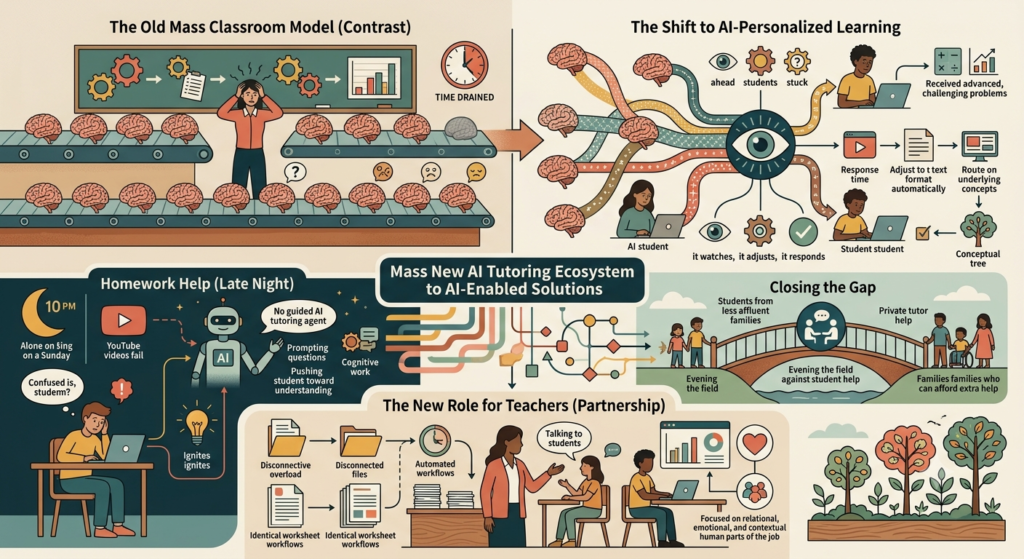
No single person can do all of that for thirty students at once. Something always gets missed. Usually, it’s the students who are either too far ahead to be challenged or too far behind to keep up.
This isn’t a teaching problem. It’s a design problem. And AI is starting to fix the design.
Personalized Learning AI: The Part That Actually Changes Things
“Personalized learning” gets thrown around a lot — sometimes to the point of sounding like buzzword fluff. But what personalized learning AI actually does is pretty straightforward.
It watches how a student works. How long does it take them to answer? Where do they slow down? What content format — video, text, interactive problems — tends to get better results from them specifically?
Then it adjusts. Automatically, without the student having to ask.
How AI personalizes student learning experiences in a real platform looks like this: a student keeps getting fraction problems wrong in a specific way. The system doesn’t just mark them incorrect and move on. It routes them back through the underlying concept, tries a different explanation format, and only advances when the error pattern actually changes.
That’s the kind of responsiveness even excellent teachers can only partially provide — because there are twenty-nine other students in the room.
AI Tutoring Systems: Homework Help That Doesn’t Judge You
Here’s a scenario that probably sounds familiar. It’s 10 PM. You’ve got an assignment due tomorrow. You’re stuck on something you don’t fully understand, you’ve watched two YouTube videos that didn’t help, and there’s no one to call. You either push through confused or submit something incomplete.
AI tutoring systems exist specifically for that moment.
The better ones don’t just spit out answers — which matters. Being handed a solution you don’t understand doesn’t help you learn anything. Good AI tutoring tools use a guided approach: they ask questions back, give hints, push the student toward the answer rather than just serving it up.
And they’re available at 10 PM on Sunday without making anyone feel stupid for not knowing something.
For students without access to private tutors — which is most students — this is genuinely meaningful. The best AI tools for online tutoring are starting to close a gap that has existed for a long time: between students whose families can afford extra help and students who have to figure it out alone.
What Changes for Teachers
There’s a version of this conversation where AI in education sounds like a threat to teachers. It isn’t.
A significant chunk of what teachers spend their hours doing has nothing to do with actually teaching. Grading stacks of identical worksheets. Entering attendance data. Writing progress report comments for every single student. These tasks matter administratively, but they don’t require the skills that make a great teacher great.
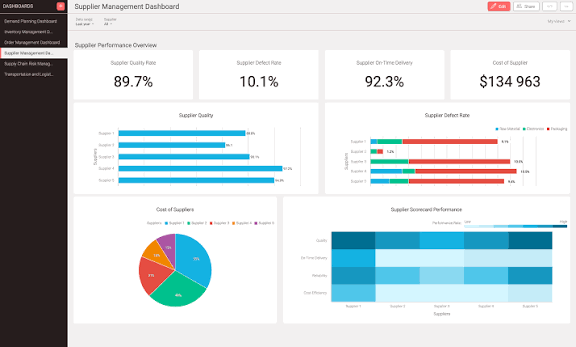
AI can handle a lot of that. Automated grading for objective assessments. Pattern recognition that flags which students are falling behind and in what specific areas. Dashboards that give a clear picture of where the class is struggling without hours of manual analysis.
What that frees up is time and attention. A teacher not buried in paperwork can actually talk to the student who’s been quieter than usual, design a lesson based on last week’s data, and focus on the human parts of the job.
That’s not AI replacing teachers. That’s AI making space for teachers to do what they’re actually there to do.
Conclusion
Nobody learns well when the system doesn’t account for who they are. That’s been the core weakness of mass education since it started — and it’s not something any individual teacher has been able to fully solve.
AI in education doesn’t fix everything. But it chips away at the structural problems: the one-size-fits-all delivery, the lack of support outside school hours, the administrative overload pulling teachers away from students.
The tools are still improving, and implementation is uneven across schools. But the direction is right. A system that adjusts to the learner, rather than demanding the learner adjust to the system, is long overdue.
Frequently Asked Questions
1. What does AI in education actually look like day-to-day? It varies by school and platform. Some students use adaptive learning software that adjusts difficulty in real time. Others access AI tutoring systems for after-hours help. Teachers might use AI-powered grading tools or dashboards showing which students need attention. It tends to layer into existing workflows rather than replacing them entirely.
2. How does personalized learning AI decide what a student needs? Mostly through pattern recognition — response time, error types, and which content formats work better. Over time, the system maps a learner’s habits and gaps, then routes them toward content and pacing that fits.
3. Won’t students just use AI tutoring systems to cheat? Well-designed tools are built to prevent this. Instead of handing over answers, they guide students through the reasoning — asking prompting questions, offering hints, and making the student do the cognitive work. How students use any tool is partly a design question and partly a classroom culture one.
4. Is AI going to replace teachers? No. What AI handles — repetitive grading, data tracking, content delivery — is different from what teachers do. The relational, emotional, contextual work of teaching isn’t something a system can replicate. Reducing administrative burden actually gives teachers more capacity for the human parts of the job.
5. What are some of the best AI tools for online tutoring available now? Khan Academy’s Khanmigo is widely discussed. Socratic by Google covers homework questions across subjects. Many LMS platforms are integrating adaptive AI features directly. The space is shifting quickly — quality varies, so it’s worth checking how a tool handles guidance versus just giving answers before relying on it.