A few months back, a game boss stopped falling for my usual combo halfway through the fight. It adjusted mid-battle. That tiny moment is basically the whole AI in the gaming industry story shrunk down to one boss room, minus the part where the same tech now builds entire worlds too. Studios lean on machine learning for level design, dialogue, testing, and deciding what a player sees next. This piece covers what that looks like day-to-day and which AI game development tools are worth your time.
What Is AI in the Gaming Industry
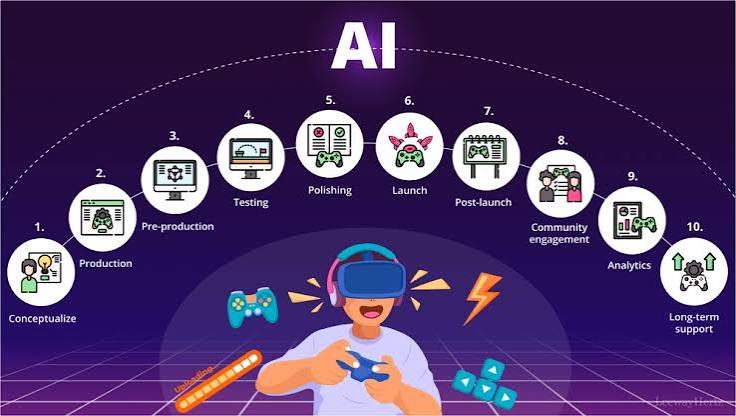
AI in the gaming industry refers to software that learns from patterns and data to help build, test, or run video games, rather than following a fixed script every time. It shows up in NPC behavior, level design, art, and dialogue.
Older games leaned on scripted logic for almost everything. An enemy walked a set path, a quest triggered on a fixed condition, and that was that. It worked well enough for years, but eventually players noticed the patterns. Machine learning changes the equation by letting systems adjust on their own. A McGill University research overview notes that machine learning is increasingly used to generate content and adapt gameplay in real time.
How AI Game Development Tools Actually Work
Most AI game development tools run on trained models paired with real-time player data. A model learns from examples, then applies what it picked up while the game runs. For NPC behavior, developers often turn to reinforcement learning, in which an agent tries actions and gradually improves.
Art works differently. Generative models trained on huge datasets can spit out new textures or scenes from a short prompt. Procedural content generation takes that further, building entire worlds automatically without a big art team behind them.
Key Features Studios Are Using Right Now
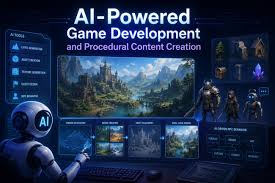
Modern AI tools cluster around a handful of core capabilities. Adaptive difficulty watches how a player is doing and quietly adjusts enemy strength. Procedural world generation builds terrain and dungeons from algorithms. Voice generation lets studios produce NPC speech without booking an actor for every line. Automated playtesting sends AI agents through a level thousands of times, catching bugs before release. None of this replaces human designers; it clears out repetitive work so people focus on what needs a human eye.
Pros and Cons of AI in Game Development
Speed is the obvious win. Tasks that once took weeks now happen in hours. Smaller studios benefit the most, since AI tools let a five-person team put out content that once needed fifty.
There are real tradeoffs too. Content built purely by AI can feel generic without a human curating it. Running large models costs money, so teams need to budget for compute. Bias in trained models is another concern, and job displacement for artists is a live debate.
Pricing for Popular AI Tools
Pricing swings a lot by tool type. Procedural generation plugins for Unreal or Unity are often one-time purchases between fifty and two hundred dollars. Cloud-based voice and art tools usually run twenty to one hundred a month, while enterprise testing platforms are custom quoted based on game size.
Best Use Cases
Open-world games benefit heavily from procedural generation, since manually building thousands of square kilometers of terrain is not realistic for most teams. Live service games use adaptive difficulty to keep players engaged. Indie studios use AI art tools to stretch small budgets, letting tiny teams ship visuals that a bigger department once handled.
Comparison Table: AI Tools for Game Development
| Tool Type | Best For | Free Plan | Typical Rating |
| Procedural World Generators | Open world and survival games | Some offer a limited free tier | 4.4 out of 5 |
| AI Voice and Dialogue Tools | NPC speech and localization | Rare, mostly paid | 4.2 out of 5 |
| Automated Playtesting Bots | Bug and balance testing | Limited trials only | 4.5 out of 5 |
| AI Art and Asset Generators | Concept art and textures | Often has a free tier | 4.3 out of 5 |
Alternatives Worth Exploring
If a studio is not ready to go all in on AI, there are middle-ground options. Traditional procedural generation without machine learning is still reliable and cheaper to run, and outsourcing playtesting to human QA firms remains solid for smaller titles.
See our guide on AI content creation tools for creators for similar workflows outside of gaming.
Hybrid workflows, where AI drafts content and a person refines it, tend to balance speed with control, and studios exploring adaptive systems may also like our piece on machine learning basics.
[INSERT IMAGE HERE: ai-tools-comparison-table.webp]
Verdict: Is AI Worth It for Game Studios
AI in the gaming industry is not a passing trend; it has become part of the standard pipeline at a lot of studios. The ones pairing automation with human direction tend to see faster production and richer experiences. Leaning on it as a full replacement risks shipping content that feels flat. Starting small beats overhauling an entire pipeline at once. Our roundup of the best AI tools for creators is a decent next stop.
For a wider look at where the industry is headed, the World Economic Forum has published research on AI’s growing role across entertainment, including gaming. [Source: weforum.org]
FAQs
Is AI replacing game developers? Not really. AI speeds up repetitive tasks, while human designers handle the story and the creative calls.
What is procedural content generation in gaming? Algorithms build parts of a game on their own, like levels or terrain, instead of a designer placing every rock by hand.
Are AI game development tools expensive for small studios? Pricing ranges widely, from a one-time fee under one hundred dollars to a monthly subscription, and many offer a free tier.
Which games already use AI heavily? Several major open-world and live-service titles rely on procedural generation and adaptive difficulty, though studios rarely name the tools they use.
Conclusion
AI in the gaming industry has moved past the hype phase into daily use across level design, testing, and art. Studios getting the most value treat it as a creative partner rather than a shortcut around good design. Trying one AI tool this year is a low-risk way to see the benefit.