My nephew typed one line into a chatbot last week and got back a fully rhymed birthday poem for his mom, written in under ten seconds, better than anything I could’ve come up with on the spot. That’s generative AI, basically — and somehow it’s become so ordinary so fast that nobody really stops to think about how strange that is.
A few years ago, this would’ve sounded like science fiction. Now it’s quietly tucked into marketing copy, code editors, even the little “suggested reply” button sitting in your inbox. So how does any of this actually happen behind the scenes?
What Generative AI Actually Means
In plain terms, it makes new things. Text, pictures, music, code, whatever you ask for. Older AI tools mostly sorted or analyzed stuff that already existed. This is different. It produces something brand new, built off patterns it picked up from an absurd amount of training data.
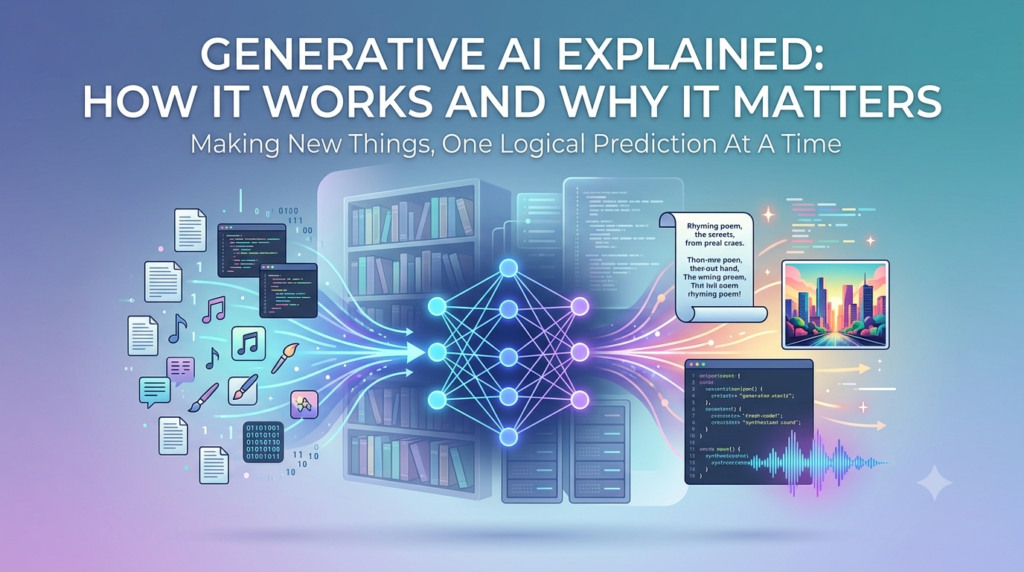
Picture someone who’s somehow read every book, article, and forum post on the internet, and then writes something fresh based on all that exposure when you ask them a question. Not copy-pasting. Predicting, one chunk at a time, what should logically come next based on everything it’s absorbed along the way.
Simple idea on paper. Messy, complicated math underneath it, though, more than most people realize.
How Generative AI Actually Works
Most of these systems run on neural networks — specifically transformers, which, no, has nothing to do with the movie robots, just an unfortunate naming coincidence. These models train on enormous datasets, picking up relationships between words, pixels, or sound well enough to guess what logically belongs next.
When you type something in, the model isn’t pulling a stored answer from a hidden database. It builds the response from scratch, piece by piece, leaning on probability the whole way. Each word — or pixel, for images — gets picked because it’s statistically the best fit given everything right before it.
That’s also why the same prompt can give two different answers on two tries. There’s randomness baked in on purpose, which is partly why outputs feel more natural than the rigid, rule-based systems from a decade back. Training all this takes a wild amount of computing power too — weeks sometimes, across thousands of specialized chips. Expensive upfront. But once trained, the thing cranks out near-endless variations almost instantly.
Generative AI Tools You’ve Probably Already Used
Odds are you’ve run into these tools without ever really clocking what they were. Text assistants draft your emails, summarize long documents, sketch outlines before you’ve opened a blank page. Image tools turn a few scattered words into genuinely polished artwork. Code assistants finish your functions before you’ve typed the closing bracket.
Then there’s audio and video — still kind of unsettling to me, honestly. Voice cloning that sounds eerily convincing. Background music generated in seconds. Short clips pulled from nothing more than a text description. None of this existed in usable form even five years back.
Plenty of businesses lean into it hard now. Marketing teams draft captions and ad copy with it daily. Support teams use it for response templates. Even some legal teams run first-pass contract reviews through it — though someone’s still double-checking before anything gets signed, obviously.
Top Generative AI Tools for Content Creation
If content’s the goal, there’s no shortage of options floating around right now. Text tools knock out blog drafts, product descriptions, and social captions faster than any single writer realistically could. Image tools spin up custom visuals for entire campaigns without tying up a full design team on every asset.
What’s kind of wild is how these tools increasingly work together — script written in one tool, voiceover generated in another, visuals pulled from a third, and somehow it stitches into a finished video without ever opening traditional editing software.
Smaller creators, who couldn’t have dreamed of affording a creative team a few years back, can now put out content that genuinely competes with bigger budgets. That alone has reshaped how a lot of small brands think about content strategy.
How Generative AI Is Changing Content Creation
Speed plus accessibility — that’s really the honest summary here. AI content generation has taken work that used to eat up days and shrunk it down to minutes for a lot of the routine stuff, which frees creators up to focus on strategy and editing instead of just grinding through first drafts.
It’s also changed who even gets to create in the first place. Someone with zero design background can put together a decent graphic now. A weak writer can still get a polished starting draft to work from. That’s a genuine shift in access — tools that used to require years of specialized training are now sitting one prompt away.
There’s a flip side worth being honest about, though. Quality control matters more than it used to, since flooding the internet with mediocre AI filler has never been easier. These tools are genuinely powerful, sure, but they still need a person steering things to keep the output actually worth reading.
The Limitations Nobody Should Ignore
This stuff isn’t magic, and it definitely gets things wrong sometimes — confidently, too, which is almost worse. Researchers call it hallucination, where the model generates something that sounds completely plausible but just isn’t true. It also tends to reflect whatever biases were baked into its training data, sometimes obviously, sometimes in ways you wouldn’t catch unless you were really looking.
There’s also a messier conversation around originality and copyright. These models learn from existing human-made work, and honestly, nobody’s fully settled the legal or ethical lines yet around what counts as derivative versus genuinely original.
Conclusion
Generative AI has gone from a niche research curiosity to something quietly shaping how people write, design, and build across nearly every industry you can name. It works by spotting patterns across massive datasets and generating new content based on probability, not memorized answers — which is exactly why it can feel so flexible, and occasionally a little unsettling in how natural it comes across. It’s far from perfect, and it’s not replacing human judgment anytime soon, but there’s no denying how much it’s already reshaped the way content gets made.
FAQs
1. Is generative AI just another word for a chatbot? Not quite. Chatbots often run on generative AI underneath, but the technology itself covers a lot more ground — images, audio, video, code — not just back-and-forth conversation.
2. Will generative AI eventually replace human creators? Unlikely, at least not entirely. It speeds up the routine stuff well, but judgment, originality, and knowing what’s actually good still need a real person in the loop.
3. Why does generative AI sometimes confidently give wrong answers? That’s hallucination — the model predicts likely-sounding text rather than checking against a verified source, so it can produce something convincing that’s just plain wrong.
4. Do small businesses need a big budget to use these tools? Not really anymore. Plenty of affordable, even free, options exist now, putting content creation within reach of creators who couldn’t have justified the cost a few years ago.