There’s a video that made the rounds a while back — a robotic arm picking up an oddly shaped object it had never encountered before, adjusting its grip mid-motion, and setting it down without dropping it. Nothing dramatic, really, just a machine adapting on the fly. But that small clip says a lot about where things stand now. AI-powered robotics isn’t about robots replacing people on some sci-fi scale anymore. It’s about machines finally getting smart enough to handle the messy, unpredictable parts of real work.
For decades, industrial robots did exactly one thing, over and over, with zero deviation. Move the arm here, weld this spot, repeat ten thousand times a day. Useful, sure, but rigid. The second something changed — a part shifted slightly, an object showed up in an unexpected position — the whole system either stalled or made a mistake. That’s the piece AI has quietly fixed.
What Actually Changed Under the Hood
The shift isn’t really about robots getting physically stronger or faster. It’s about them getting smarter at perceiving and reacting. Sensors feed constant streams of visual and spatial data into machine learning models, and those models make split-second decisions about how to adjust grip, angle, speed, whatever the task requires. The robot isn’t just executing a fixed script anymore — it’s responding to what’s actually in front of it.
Industrial robotics automation used to mean predictability above all else. Now it means adaptability too. A robot on a line can handle parts that vary slightly in size or position without needing a human to reprogram it every time something’s off by a few millimeters. Doesn’t sound like much written out like that, but on a factory floor running thousands of cycles a day, it’s a massive deal.
How Industrial Robots Use AI to Work Smarter
How industrial robots use AI to work smarter usually comes down to three things working together: computer vision to “see” what’s around them, machine learning models trained to recognize patterns and anomalies, and feedback loops that let the system improve its own performance over time. Put those together and you get a robot that handles variation instead of breaking down the moment something doesn’t match the script exactly.
Take a quality inspection. Older systems checked for a few fixed defect types and missed anything outside that narrow list. AI-driven vision systems learn what “normal” looks like across thousands of examples, so they catch defects nobody explicitly programmed them to look for. That’s a pretty significant leap, honestly.
The Rise of Collaborative Robots
This is probably the part people find most interesting, since it touches something a little more personal — working directly alongside a machine rather than behind a safety cage twenty feet away.
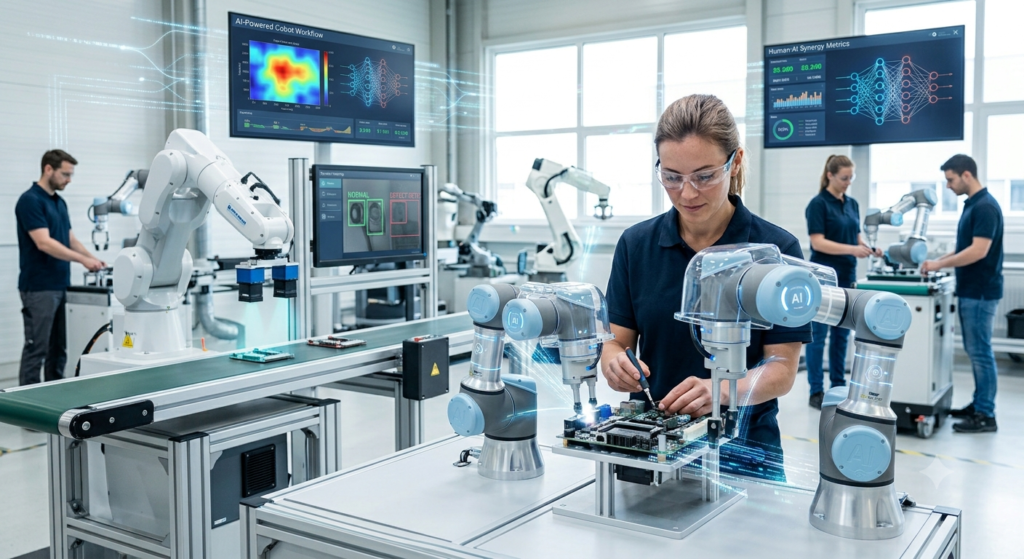
Collaborative robots, or cobots as most people in the industry just call them now, are built specifically to operate near humans without the heavy fencing and emergency stop barriers traditional industrial robots needed. Sensors detect a hand or person nearby and the robot slows down or stops automatically. No programming required for every scenario — it just reacts.
How Collaborative Robots Work Alongside Humans
How collaborative robots work alongside humans really comes down to shared tasks rather than full automation. A cobot might hold a part steady while a technician does the precision work, or hand off components on an assembly line at exactly the pace a worker needs, no faster, no slower. It’s less about replacing the human and more about removing the repetitive, physically taxing parts of a job.
Workers who’ve used cobots day-to-day tend to describe it less like “working with a robot” and more like having an extra pair of hands that never gets tired and never complains about doing the boring part of the task again and again.
Where This Is Showing Up Right Now
Automotive manufacturing was an early adopter, unsurprisingly — assembly lines have used robotics for decades, so layering AI on top was a natural next step. Warehousing and logistics picked it up fast too, with robots now navigating dynamic environments full of moving people and shifting inventory, something that would’ve been borderline impossible a decade ago.
Food processing, electronics assembly, even some agricultural operations are getting in on this now. Wherever there’s repetitive work mixed with just enough variability to confuse a traditional fixed-program robot, AI-powered systems tend to find their way in eventually.
What This Means for the Workforce
The fear of robots taking jobs gets a lot of airtime, and it’s not entirely unfounded — some repetitive roles genuinely are shrinking. But the more common pattern looks more like role-shifting than outright replacement. Workers move from doing the repetitive task themselves to supervising and maintaining the systems that do it. Different job, not necessarily a worse one, though the transition isn’t always smooth for everyone.
Conclusion
AI-powered robotics has moved past the stiff, single-task machines of a decade ago into something far more adaptive — robots that see, react, and in the case of cobots, actually share space with the people working next to them. Industrial robotics automation keeps getting smarter at handling the unpredictable parts of production, and collaborative robots are changing what it even means to work “alongside” a machine. None of this erases the human role on the floor; it mostly reshapes it. The industries leaning into this now are likely to be the ones setting the pace for everyone else.
FAQs
1. What’s the difference between traditional industrial robots and AI-powered ones? Traditional robots follow a fixed script with no flexibility. AI-powered ones can perceive their environment and adjust their actions in real time when something doesn’t match expectations.
2. Are cobots safe to work next to without protective barriers? Generally, yes. Cobots are designed with sensors that detect nearby humans and automatically slow or stop, which is what allows them to operate without the heavy fencing older robots required.
3. Will AI-powered robotics eliminate manufacturing jobs? Some repetitive roles are shrinking, but the more common shift is workers moving into supervising, maintaining, or working alongside these systems rather than losing their jobs outright.
4. Which industries are adopting AI robotics fastest? Automotive, warehousing, and logistics have led the way so far, with food processing and electronics assembly catching up quickly.
5. Do small manufacturers have access to this technology? Increasingly, yes. Costs have come down enough that mid-sized operations can adopt cobots or AI vision systems without the massive budgets once required.