A bank in Singapore caught a fraudulent transaction in under two seconds last year. Two seconds. A human analyst would’ve needed hours just to notice something was off. That’s not futuristic anymore — it’s just Tuesday for AI in cybersecurity at this point. Most people have no clue how much of this runs quietly in the background every time they swipe a card or log into their bank app.
Cyber threats have gotten faster and sneakier than ever, honestly. Traditional security setups — fixed rules, manual review — just weren’t built for this pace. And that gap is exactly where AI walked in and quietly rewired how the whole industry operates.
Why Traditional Cybersecurity Started Falling Behind
I once talked to a security analyst who put it bluntly: her team was always a step behind. By the time anyone reviewed yesterday’s alerts, the attacker had already moved on. Sound familiar? That lag is really the root of the problem.
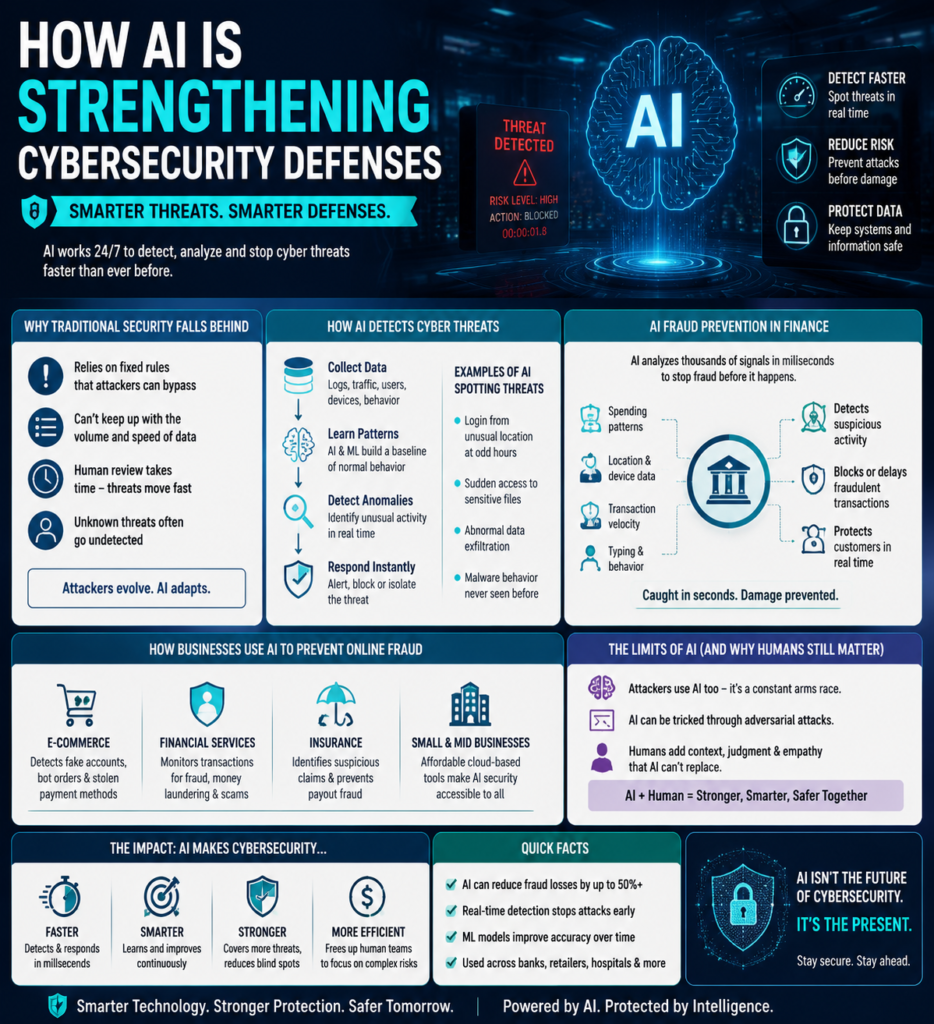
Rule-based systems only flag what they’re explicitly told to flag. The second an attacker tweaks their method slightly, those rules become decorative. Throw in the sheer volume of data modern networks churn out daily — way more than any human team could realistically sift through — and you’ve got a system bound to miss things sooner or later. That’s pretty much why AI threat detection exists.
How AI Detects Cyber Threats in Real Time
Picture this: someone logs into a company account from a city they’ve never been to, at 3 AM, and starts downloading files they haven’t touched in two years. A human reviewer might catch that the following Monday, if they’re lucky. AI catches it instantly, because it already knows what “normal” looks like for that person and flags the deviation right away.
That’s the shift, more or less. Instead of matching activity against a list of known bad signatures, the system builds a baseline of what’s normal and watches for anything that breaks from it — including threats nobody’s ever documented before.
Machine learning models churn through network traffic, login behavior, and file activity nonstop, comparing what’s happening now against patterns built from months, sometimes years, of historical data. An odd login location at an odd hour, a sudden spike in copied files, an account suddenly poking around files it’s never touched — these get flagged almost instantly instead of sitting in a queue for days.
What sets this apart from older systems isn’t just speed, though that matters plenty. It’s speed paired with context. AI doesn’t just shout “suspicious!” and leave it there — a lot of the time, it can explain why, cross-checking dozens of data points at once in a way no human team could manage manually.
AI Fraud Prevention Tools and the Financial Sector
Fraud, more than most other cyber threats, comes down to timing. A fraudulent transaction has to be caught before it clears, not after, which is basically why AI fraud prevention tools have become central to how banks and payment platforms run things now.
These systems track transaction patterns in real time: spending habits, usual locations, device fingerprints, and even how fast someone types in their card number. Over time, this builds a behavioral profile unique to each user. The moment something breaks from that profile in a big way, the system can flag, delay, or block the transaction within milliseconds — often before the money’s even left the account.
It’s not perfect, and probably never will be. False positives happen, and most of us have had a card declined for something totally innocent that just looked unusual on paper. But honestly, that tradeoff makes sense — a little friction beats letting actual fraud slip through because nobody was watching closely.
How Businesses Use AI to Prevent Online Fraud
It’s not just banks leaning on this. Plenty of regular businesses use AI for fraud prevention without customers ever noticing. E-commerce platforms run it quietly to catch fake signups, and it’s gotten surprisingly good at spotting bot-driven purchases too — stolen card usage gets caught this way often enough that it’s basically routine now. Insurance companies feed claims through similar models trained to spot patterns common across fraudulent claims, the kind of subtle stuff a human reviewer might easily miss across thousands of cases.
What surprised me, honestly, when I first looked into this — smaller businesses are getting in on it too. Cloud-based fraud detection has gotten affordable enough that even a mid-sized online store can plug into systems originally built for the big players. No in-house data science team needed anymore. A lot of it just comes pre-built, ready to go.
The Limits AI Still Has in Cybersecurity
None of this means AI has solved cybersecurity for good, and it’s worth being upfront about that. Attackers use AI too now, which has turned this into a back-and-forth where both sides keep adapting just to stay ahead. AI models can also get fooled if attackers figure out how the system makes its decisions — researchers call this an adversarial attack, and it’s a real, growing concern.
There’s also the human piece AI can’t replace, at least not yet. Reading context, making calls when things are genuinely ambiguous, talking to a customer upset about a frozen account — that still needs a person. AI works best as a force multiplier for security teams, not a replacement.
Conclusion
AI in cybersecurity has gone from a nice extra to a baseline expectation, especially for anyone handling financial transactions or sensitive data. From catching threats in real time to running fraud prevention behind nearly every online purchase, AI has changed how fast — and how accurately — businesses respond when something goes wrong. It’s far from flawless, and it’ll never fully replace solid security practices on its own, but it’s hard to picture modern cybersecurity working without it anymore.
FAQs
1. How does AI actually improve cybersecurity compared to older methods? It can chew through massive amounts of data in real time and catch unusual patterns that rule-based systems would completely miss, especially threats that don’t match anything seen before.
2. Can AI fully take over for human cybersecurity teams? Not really, no. AI’s great at detection and speed, but you still need human judgment for context, tricky decisions, and anything that falls outside what the system was originally trained on.
3. How fast can AI actually catch a cyber threat or fraudulent transaction? Usually within milliseconds, sometimes a few seconds, depending on the system. Compare that to manual review, which can drag on for hours or even days.
4. Does AI fraud detection flag a lot of false positives? Occasionally, yes — a legit purchase might get flagged now and then. But most systems are tuned to keep that friction low while still catching the real fraud attempts.
5. Can small businesses actually afford AI-based fraud prevention? Yes, more than people realize. Cloud-based AI security tools have gotten cheap enough that smaller online stores now have access to fraud detection that used to be reserved for big enterprises only.