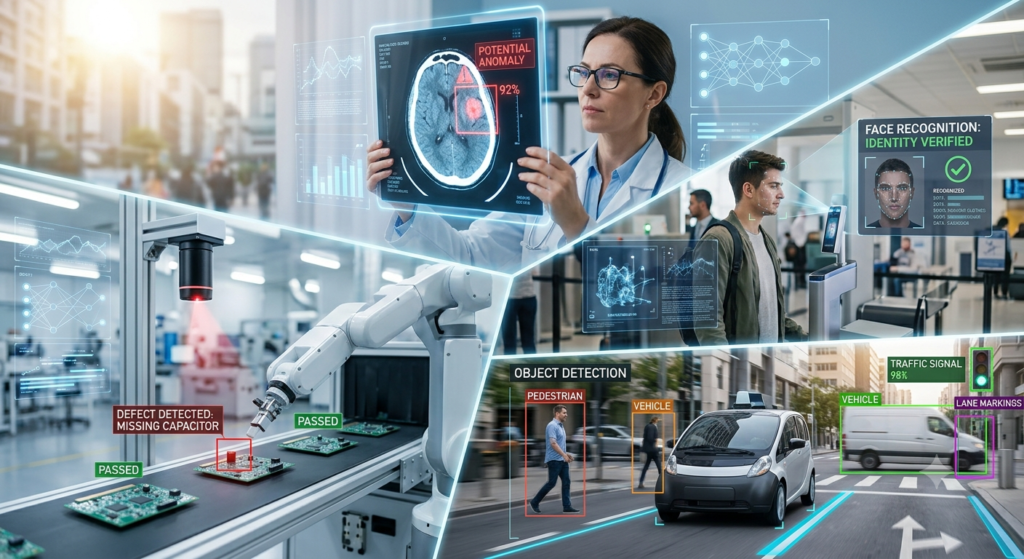
Ever unlocked your phone just by looking at it and not really thought twice about it? That’s computer vision technology working in the background, and most people don’t even register it as “AI” anymore — it’s just become normal. Which, honestly, says a lot about how far this stuff has come in such a short time.
A decade ago, getting a computer to reliably recognize what’s in an image was still a hard problem. Now it’s everywhere — checkout lines, hospitals, traffic cameras, your phone’s photo app sorting pictures of your dog without you asking it to. Let’s get into how this actually works and why it’s spreading into so many industries at once.
What Computer Vision Actually Does, In Plain Terms
Okay, so here’s the simple version. Computer vision technology basically teaches a machine to look at something and figure out what it’s looking at — kind of like how you instantly know that’s a coffee mug and not a cup of tea, except the computer has to learn that from scratch, one example at a time. No magic involved, despite what the marketing decks sometimes imply. It’s pattern matching, just done at a scale no human brain could manage.
Image recognition systems sit underneath most of this. Show a model thousands (sometimes millions) of labeled pictures — cats, road signs, cracked bolts on a factory line, you name it — and somewhere in there it starts noticing what separates one thing from another. Give it something brand new, it’s never seen before, and more often than not, it still gets it right.
How AI Image Recognition Works in Real Life
Here’s where it gets practical. How AI image recognition works in real life usually boils down to a camera capturing visual data, that data getting processed through a trained neural network, and the system spitting out a prediction — “this is a pedestrian,” “this is a defective bolt,” “this is a tumor that needs a closer look.” All of that can happen in milliseconds.
What makes it useful isn’t just speed, though that helps. It’s consistency. A human inspector gets tired by hour six of a shift. A model running the same task doesn’t.
Where This Shows Up Across Industries
Retail
Self-checkout, inventory tracking, even those cashier-less stores — all of it leans on image recognition systems to identify products and track what’s leaving the shelves. Retailers also use it to study foot traffic, mostly just to figure out better shelf placement, not to track individuals (well, ideally not).
Healthcare
This one carries the highest stakes. Radiologists now use computer vision tools to flag potential abnormalities in scans — not replacing a doctor’s judgment, just acting as a second set of eyes that never gets tired. Some studies suggest these systems catch things that get missed on a busy day, which matters quite a bit when early detection is on the line.
Manufacturing
Defect detection is one of the more mature use cases here. A camera scans products on the belt, and the model flags anything that deviates from what “good” should look like. Faster than a person, and it never blinks at the wrong moment.
Transportation
Self-driving systems — even the partial ones in regular cars today — lean almost entirely on computer vision to read lane markings, pedestrians, signals, and obstacles in real time. Arguably the highest-pressure use case of all, since mistakes here carry real physical consequences.
Facial Recognition Technology: The Controversial Cousin
Now, let’s talk about the part that makes people a little uneasy. Facial recognition technology is probably the most talked-about (and argued-about) branch of computer vision, and for good reason — it touches identity, privacy, and surveillance in ways that, say, a defect-detection camera on a factory line just doesn’t.
How facial recognition technology is being used today spans a pretty wide range. Airports use it to speed up security checks. Phones use it to unlock devices. Some retailers use it for loss prevention, flagging known shoplifters as they walk in. Law enforcement agencies use it too, which is where most of the controversy tends to concentrate, given the well-documented accuracy issues across different skin tones and lighting conditions.
It’s not that the technology is inherently bad — it’s that getting it wrong carries real weight. A mistaken product label is annoying. A mistaken identity flagged by law enforcement is a different category of problem entirely. Regulation here is still catching up.
Where This Is All Heading
Accuracy keeps improving, sure, but the bigger shift is accessibility. What once needed a research team and a serious budget is now a cloud API a small business can plug into without hiring a single ML engineer. That’s lowering the barrier across nearly every industry mentioned above.
Conclusion
Computer vision technology has gone from research curiosity to something woven into daily life, often so seamlessly we barely notice. Retail, healthcare, manufacturing, transportation, security — there’s barely an industry untouched by image recognition systems in some form. The applications that get headlines, like facial recognition, also raise real privacy questions that aren’t going away soon. Still, the direction is clear: this isn’t slowing down, and the industries figuring out how to use it responsibly now are likely the ones who benefit most later.
FAQs
1. What’s the difference between computer vision and image recognition? Image recognition is a subset of computer vision. Computer vision is the broader task of interpreting visual data. Image recognition is the specific task of identifying objects or patterns within an image.
2. Is facial recognition technology accurate? It depends a lot on the system and conditions. Accuracy has improved significantly in recent years, but performance still varies — particularly across different lighting conditions and skin tones, which remain an active area of research.
3. Which industries benefit most from computer vision right now? Healthcare, manufacturing, and retail are probably leading the pack at the moment, though transportation is catching up fast with self-driving technology.
4. Do small businesses actually have access to this technology? Yes, more than you’d expect. Cloud-based computer vision APIs have made it possible for smaller companies to use this tech without building their own models from scratch.
5. Is computer vision technology replacing human jobs? In some narrow tasks, yes, repetitive visual inspection is one example. But in most cases, it’s acting more as a support tool, handling the tedious first pass so humans can focus on judgment calls.